
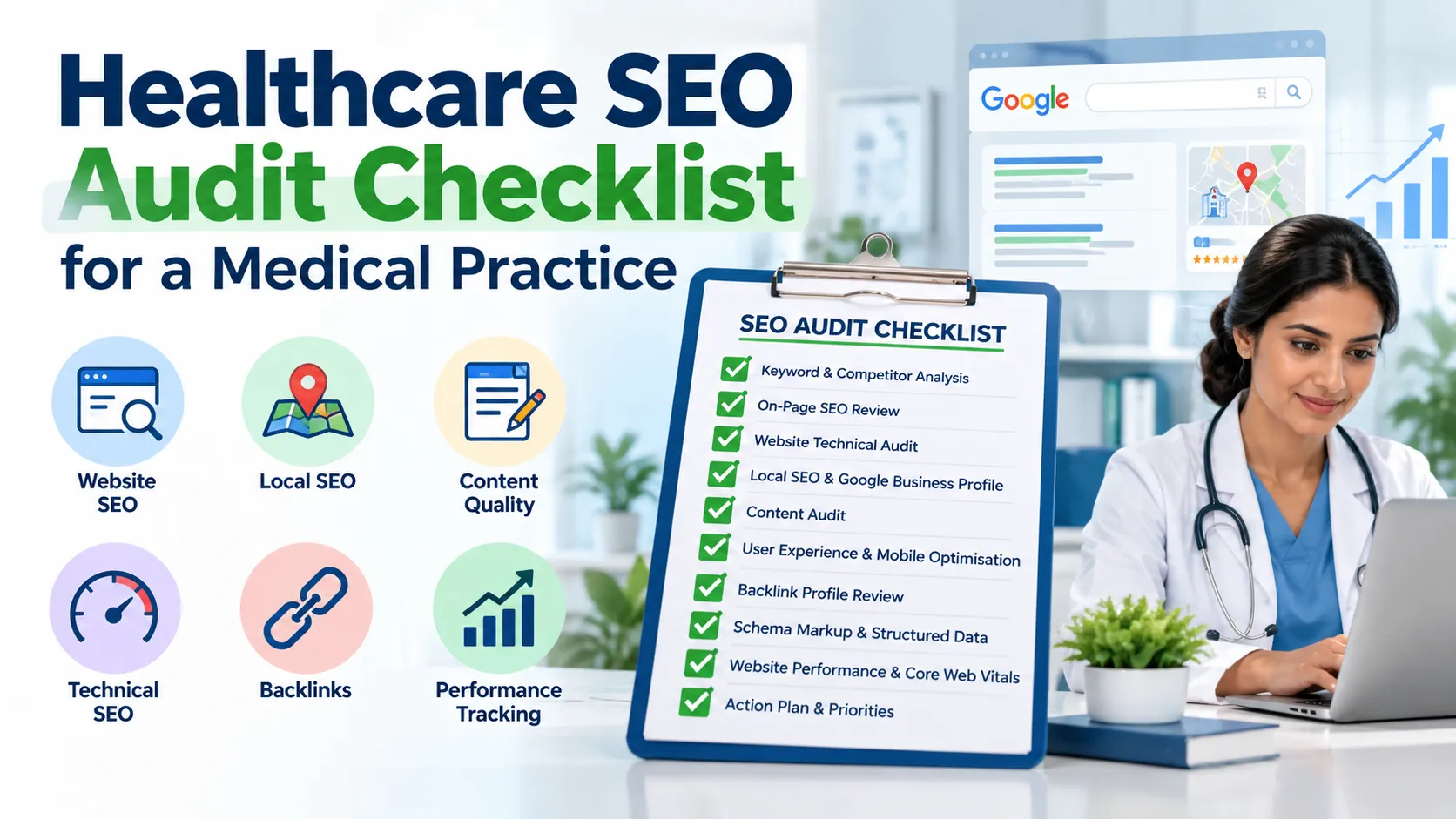
A practical, step-by-step guide for clinic managers, healthcare business leaders, and marketing teams
A medical practice can offer excellent care and still struggle to attract relevant visitors through organic search. The problem may involve technical errors, unclear service pages, weak local visibility, outdated information, or content that fails to answer patients’ questions. Without a structured audit, teams may spend time improving individual pages while overlooking issues affecting the wider website.
A healthcare SEO audit checklist provides a systematic way to identify these problems, assess their importance, and plan corrective action. It examines how search engines access a website, how patients navigate its content, and how clearly the practice communicates its services and location.
Healthcare websites also require particular attention to accuracy, privacy, and professional credibility. Their content can influence decisions about health services, so marketing teams should evaluate more than rankings and traffic.
This guide explains how to audit a medical website step by step, prioritize technical and content improvements, and measure progress without relying on guaranteed rankings or patient acquisition claims.
Why Does a Medical Practice Need an SEO Audit?
A website can look professional and still have significant search visibility problems. Search engines may struggle to discover important pages, mobile visitors may encounter usability issues, or service descriptions may fail to match the language people use when looking for care.
An SEO audit helps identify these weaknesses before the team commits resources to a larger optimization campaign.
For healthcare business leaders, the audit should answer five practical questions:
- Can search engines discover and index the pages that matter?
- Can visitors quickly understand the practice’s services and location?
- Does the content answer relevant questions accurately?
- Does the website provide a reliable experience across devices?
- Can the team measure organic visibility and meaningful visitor actions?
A useful medical website SEO checklist therefore combines technical checks, content evaluation, local search optimization, usability reviews, and measurement.
The objective is not to change every page at once. It is to identify the issues that create the greatest barriers to discovery, understanding, and contact.
Understand the Key Principles of Healthcare SEO
An effective audit evaluates the relationship between technical accessibility, content relevance, user experience, and trust.
- Technical accessibility : Search engines need to discover, crawl, and process a website’s important pages. Broken links, incorrect indexing directives, server errors, and poorly managed duplicate URLs can interfere with that process.
- Search intent and content relevance : A page should satisfy the reason behind a search. Someone searching for a clinic’s address needs location information, while someone researching a specialty may need an explanation of services, qualifications, and appointment procedures.
- Trust and professional credibility : Healthcare content should identify its author or reviewer where appropriate, use reliable references, and communicate limitations honestly.
- Local discoverability : Accurate contact details, service information, location pages, and a properly maintained Google Business Profile help patients understand where a practice operates.
Step-by-Step Healthcare SEO Audit Process
The following workflow is designed for clinic managers and healthcare marketing teams. Complete the baseline audit before making substantial changes, so the team can compare results afterward.
Step 1: Establish a performance baseline
Start with Google Search Console and Google Analytics, if configured.
In Search Console, review the Performance report to examine organic clicks, impressions, click-through rate, and average position. Segment the data by query, page, device, and relevant location information where available. Compare recent performance with an earlier equivalent period, accounting for seasonality and changes in demand.
Next, record relevant website actions, such as appointment-form submissions, calls initiated from the website, and clicks on appointment links. Analytics tracking must be configured correctly before these actions can be interpreted as conversions.
Create a baseline spreadsheet with these columns:
- Page URL and page type
- Primary search intent
- Organic clicks and impressions
- Indexing status
- Main technical or content issue
- Recommended action
- Priority and responsible person
Decision rule: If organic visibility is declining, determine whether the decline affects the entire website, a specific specialty, or a small group of pages. This distinction helps narrow the investigation.
Step 2: Audit crawling and indexing
Open the Page indexing report in Google Search Console. Review which pages are indexed and investigate the reasons important pages are excluded.
Prioritize the homepage, specialty pages, individual service pages, doctor profiles, and location pages.
Check the following:
- Important pages return successful HTTP responses.
- The robots.txt file does not unintentionally block important resources or pages.
- Pages intended for search visibility do not carry an accidental
noindexdirective. - XML sitemaps include relevant canonical URLs.
- Canonical tags identify the preferred version of duplicate or similar URLs.
- Important pages are accessible through internal links.
Not every excluded URL is a problem. Duplicate pages, redirected URLs, and intentionally excluded pages may be correctly absent from the index. Google recommends evaluating the reason for exclusion instead of trying to achieve universal indexing.
Step 3: Evaluate healthcare technical SEO
A healthcare technical SEO review should examine performance, mobile usability, site architecture, and the technical elements that affect crawling and page interpretation.
Check website performance. Use PageSpeed Insights to investigate slow loading, layout shifts, and interaction delays. Review Core Web Vitals where field data is available. Optimize oversized images, reduce unnecessary scripts, and evaluate caching or hosting limitations. Avoid assuming that every performance warning has the same business impact.
Test mobile usability. Review key pages on different screen sizes. Confirm that text remains readable, menus work, forms are easy to complete, and appointment buttons do not overlap other elements. Google primarily uses the mobile version of website content for indexing, making mobile content parity important.
Step 4: Audit service pages and on-page SEO
Each important service page should answer a clear question and reflect a distinct search intent.
For every page, inspect:
- Title tag: Does it accurately describe the service and, where appropriate, the location?
- Meta description: Does it summarize the page clearly and give searchers a useful reason to visit?
- Main heading: Can visitors immediately understand the page’s purpose?
- Body content: Does it explain the service, relevant qualifications, process, limitations, and next steps?
- Internal links: Can visitors navigate to related services, doctor profiles, and appointment information?
- Images: Are they relevant, appropriately sized, and supported by descriptive alternative text when meaningful?
- Calls to action: Can visitors find accurate contact information and understand how to request an appointment?
Avoid creating multiple pages that repeat nearly identical content for minor keyword variations. A page should exist because it serves a distinct user need, not simply to target another phrase.
Step 5: Review medical content quality
Healthcare content requires careful editorial review because inaccurate or exaggerated statements can undermine trust.
Check whether each article or service page:
- Uses credible, relevant sources for factual medical claims.
- Identifies the author, reviewer, or relevant professional credentials when appropriate.
- Explains medical terminology in accessible language.
- Distinguishes general information from individualized medical advice.
- Avoids unsupported treatment claims, guaranteed outcomes, and misleading comparisons.
- Includes a review or update process for information that can change.
- Provides useful information rather than repeating keywords unnecessarily.
The marketing team should involve a qualified healthcare professional when medical accuracy requires specialist judgment. Content optimization should never override clinical accuracy.
Step 6: Examine local SEO and Google Business Profile
For clinics serving a defined geographic area, local search visibility is an important part of the audit.
Verify that the Google Business Profile contains accurate business details, the correct address or service-area configuration, relevant categories, current hours, and appropriate contact information.
Then compare those details with the website and other legitimate business listings. Investigate differences in clinic names, addresses, phone numbers, and opening hours.
Review the website’s location pages for genuine local relevance. A useful page may explain the clinic’s location, specialties, accessibility, and appointment process. Avoid publishing near-identical location pages for areas the practice does not genuinely serve.
Step 7: Evaluate conversion paths and privacy
An SEO audit should not stop when visitors reach the website. Check whether people can understand the next step and complete it without unnecessary friction.
Test appointment forms, phone links, email links, directions, and other contact methods. Verify that forms work on mobile devices and display useful error messages.
Healthcare websites also need careful privacy controls. Collect only the information necessary for the stated purpose, restrict access to submitted data, and review how analytics tools, advertising pixels, embedded services, and form plugins process information.
For Indian organizations, assess the applicability of the Digital Personal Data Protection Act, 2023, and the relevant rules and commencement provisions. The Ministry of Electronics and Information Technology publishes official information on the legislation.
Illustrative Example: Auditing a Clinic Website
Consider a hypothetical multispecialty clinic whose marketing team notices that its service pages receive few organic visits.
The team identifies three issues during its audit:
- A high-value service page is excluded from indexing because of an unintended directive.
- Several service pages have vague titles that do not clearly identify the services.
- The mobile appointment form fails to submit reliably.
The team records the affected URLs, confirms the causes, assigns the technical fix to the developer, and asks the content team to revise the page titles. It also tests the appointment form across mobile devices.
After the changes, the team checks indexing status, monitors organic clicks and impressions, and tests form submissions again.This example illustrates an audit workflow, not a real client result. The outcome should be assessed using actual website data rather than assumed improvements.
Common SEO Audit Mistakes to Avoid
- Treating every warning as urgent
- Focusing only on keywords
- Publishing location pages at scale without genuine value
- Changing URLs without a migration plan
- Expecting immediate results
- Ignoring privacy during conversion optimization
Conclusion: Turn the Audit into an Action Plan
A structured SEO audit for clinics helps healthcare teams identify technical barriers, improve service-page relevance, strengthen local visibility, and provide a more reliable website experience. The most effective approach combines evidence from Search Console and analytics with technical testing, editorial review, local profile checks, and privacy safeguards.
Start with issues that prevent discovery or disrupt important patient journeys. Next, improve the accuracy and usefulness of service content, then address secondary performance and internal-linking opportunities. Document every change and verify its effect instead of assuming that a completed task automatically improves rankings.
For teams that need specialist support, Doctors Branding Agency’s relevant healthcare SEO service page can provide the next point of reference for reviewing service scope, deliverables, and the approach to ongoing optimization.
- Phone : +91 95601 46696
- WhatsApp : Chat on +91 95601 46696 (opens in a new tab)
- Email : info@doctorsbranding.agency
- Office:3rd Floor, 58 Mahakal Enclave, Doctor BC Roy Road, Shyamnagar, West Bengal 743127, India
- Hours :Open 24 hours Every day of the year

admin_sjdb
Want this kind of thinking applied to your practice?
Start with a conversation about where your doctor, clinic or hospital marketing stands today.