
How to Find Content Gaps Between Your Clinic and Local Competitors?
A practical clinic content gap analysis: pick real local rivals, compare patient questions, classify the gaps, and measure whether new pages actually help.
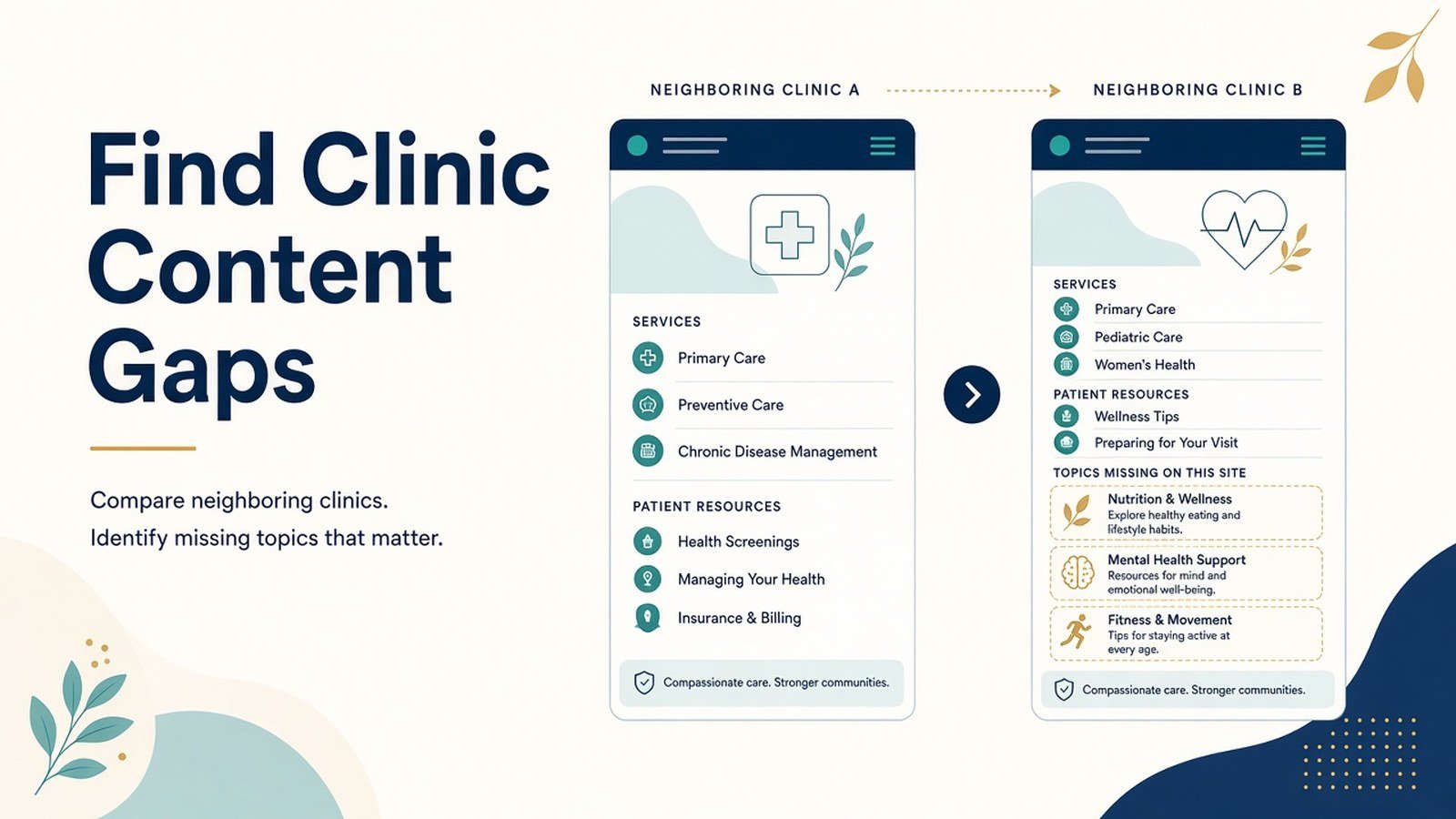
A patient searching “how long does root canal healing take” rarely compares clinics on credentials first. They click whichever result answers clearly. If the orthopaedic practice two streets away has a page explaining recovery timelines and yours doesn’t, that practice gets the visit, the trust and often the appointment.
That’s what a content gap is: a question your likely patients are asking, which competing clinics answer on their websites and you don’t (or answer poorly). Finding those gaps is the most practical part of any healthcare competitor SEO analysis, because it turns vague worries (“they rank better than us”) into a specific list of pages to write or improve.
Here’s how clinic managers and marketing teams can run that analysis themselves, and how to tell whether it’s working.
Why content gaps matter more for clinics than most businesses?
Local healthcare search behaves differently from general search. Most clinic queries carry local intent, so the competition isn’t every hospital in India. It’s the five or ten practices that show up when someone in your catchment area searches.
That’s good news. You don’t need to outwrite national health portals, only to be more useful than the clinics a patient could realistically visit.
There’s also a quality bar. Google treats health topics as “Your Money or Your Life” content, and its guidance on creating helpful content explains why its systems place extra weight on experience, expertise and trustworthiness for pages that could affect someone’s health. A thin page written to fill a keyword slot won’t close a gap; a clinician-reviewed page in plain language might.
The principles behind a useful gap analysis
Before opening any tool, settle three ground rules.
- Compare against real competitors, not imagined ones. Your business competitors (the clinics patients actually choose between) and your search competitors (the sites that rank for your topics) overlap but aren’t identical. Directories may outrank everyone, but you can’t become one, so focus on clinics with a comparable service mix.
- Organise by patient intent, not keyword lists. “PCOS treatment Kolkata,” “PCOS diet chart” and “can PCOS be cured” are three different needs: finding a provider, self-managing, and understanding a condition. Grouping keywords by the question behind them stops you from writing three near-identical pages.
- Treat a gap as an opportunity, not an obligation. If a rival publishes content outside its clinical scope, copying it isn’t a gap worth filling.
A step-by-step method for clinic content gap analysis
Step 1: Pick four to six true local competitors
Search your three or four most important services the way a patient would, including location modifiers (“gynaecologist in Salt Lake,” “dental implants Howrah”). Use an incognito window so your browsing history doesn’t skew results. Clinics that appear repeatedly in the map pack and organic listings form your comparison set.
Step 2: Build an inventory of your own pages
Export every indexed URL from Google Search Console (Indexing > Pages) or a crawler like Screaming Frog. For each page, record the service or condition it covers and the main question it answers. Many clinics find one generic “Services” page doing the work of fifteen.
Step 3: Collect medical competitor keywords
Now gather the terms your competitors rank for. Tools such as Semrush, Ahrefs or Ubersuggest let you enter a competitor’s domain and see its ranking keywords. Filter to positions 1–20 and to queries relevant to your specialties. Export these medical competitor keywords, along with your own, into one spreadsheet.
On a tight budget, do it manually: browse each competitor’s service pages and blog, and list the conditions and questions they cover.
Step 4: Run competitor SERP research on priority topics
Keyword lists tell you what ranks. Competitor SERP research tells you why. For your top 15–20 topics, search each query and study page one:
- What type of page wins? A service page, a blog article, a FAQ, a video?
- Does Google show a “People also ask” box? Those questions are a free list of patient concerns.
- How detailed are the top results? Do they mention cost ranges, recovery time, preparation, or who is a suitable candidate?
- Is there a named, qualified author or medical reviewer?
This is where most gaps show up. You might rank for “laser hair removal” yet find every competitor has a page on “laser hair removal for dark skin,” a question your front desk hears constantly.
Step 5: Classify each gap
Mark every topic in your spreadsheet as one of four things:
- Missing: competitors cover it, you have nothing.
- Weak: you have a page, but it’s thinner, older or less clear than theirs.
- Misaligned: you have content, but it’s the wrong format for what the search results reward.
- Unclaimed: nobody locally covers it well, which is often the best opportunity of all.
Step 6: Prioritise
Score each gap on three factors, from 1 to 3: relevance to services you actually want to grow, likely patient demand (search volume plus front-desk frequency), and effort to produce a reviewed, accurate page. Start with high relevance, high demand and moderate effort.
Common mistakes and compliance limits
- Copying competitor content. Rewriting a rival’s page sentence by sentence is both unoriginal and risky. Use it to spot the question, then answer from your own clinicians’ experience.
- Chasing volume over relevance. Traffic from people who will never book doesn’t help a local clinic.
- Blurring marketing and medical advice. Educational pages should explain conditions and treatment options in general terms and encourage readers to consult a doctor. They shouldn’t diagnose, promise outcomes or suggest a treatment will work for everyone. In India, doctors’ promotional conduct is subject to National Medical Commission guidance, so check the current rules with your medical team before publishing claims or before-and-after material.
- Using patient stories carelessly. Any testimonial, case photo or story needs documented consent and should avoid identifying details. India’s Digital Personal Data Protection Act, 2023 applies to how personal data is collected and used, and health information deserves particular care.
- Expecting guarantees. A gap analysis improves the odds that your pages are useful and visible. It can’t guarantee rankings, enquiries or patient numbers, and anyone promising otherwise is overselling.
How to measure progress and choose the next action?
Treat measurement as the final stage of your healthcare competitor SEO analysis, not an afterthought. Give new or updated pages eight to twelve weeks, then check:
- Search Console impressions and clicks for the target queries. Rising impressions with flat clicks usually means the title and meta description need work.
- Average position trend, not day-to-day movement.
- Engagement in GA4: do visitors click through to book or call?
- Front-desk feedback. Ask reception staff whether patients mention reading something on the website. It’s informal, but often telling.
If a page gains impressions but not clicks, rewrite the snippet. If it doesn’t gain impressions, revisit the search results; the format may still be wrong. If it performs well, look for related questions to cover next. Repeat the analysis every six months; competitors publish too.
Quick action checklist
- List 4–6 genuine local competitors from real patient-style searches
- Export your indexed pages from Search Console
- Pull competitor ranking keywords and group them by patient intent
- Review page one for your top 15–20 topics
- Label each gap: missing, weak, misaligned or unclaimed
- Score and prioritise by relevance, demand and effort
- Have a qualified clinician review every new page
- Confirm consent and privacy for any patient material
- Recheck performance after 8–12 weeks
Final Words
A clinic content gap analysis comes down to one question: what are local patients trying to learn that nearby practices explain and you don’t? Answer it with a short list of real competitors, intent-grouped keywords, a close read of the search results and a simple prioritisation score. Then publish clinician-reviewed pages and measure honestly.
For a structured approach within wider search planning, Doctors Branding Agency outlines its process on its Healthcare SEO service page, including how competitor research fits into ongoing content work.
Keep reading
More from the Doctors Branding blog
-
How to Improve Internal Linking on a Medical Website?
A practical medical website internal linking method: audit orphan pages, build speciality clusters, set link rules, and check patients can...
Read article → -

Local SEO Beyond Google Business Profile: Other Signals Doctors Can Manage
Local SEO beyond Google Business Profile: other signals doctors can manage, from consistent listings and service pages to reviews and...
Read article → -
Local SEO for Diagnostic Centres and Pathology Labs
Practical local SEO for diagnostic centres: fix Google profiles, build unique lab pages, keep details consistent, and measure results for...
Read article →
Want this kind of thinking applied to your practice?
Start with a conversation about where your doctor, clinic or hospital marketing stands today.