
Local SEO Beyond Google Business Profile: Other Signals Doctors Can Manage
Local SEO beyond Google Business Profile: other signals doctors can manage, from consistent listings and service pages to reviews and structured data.
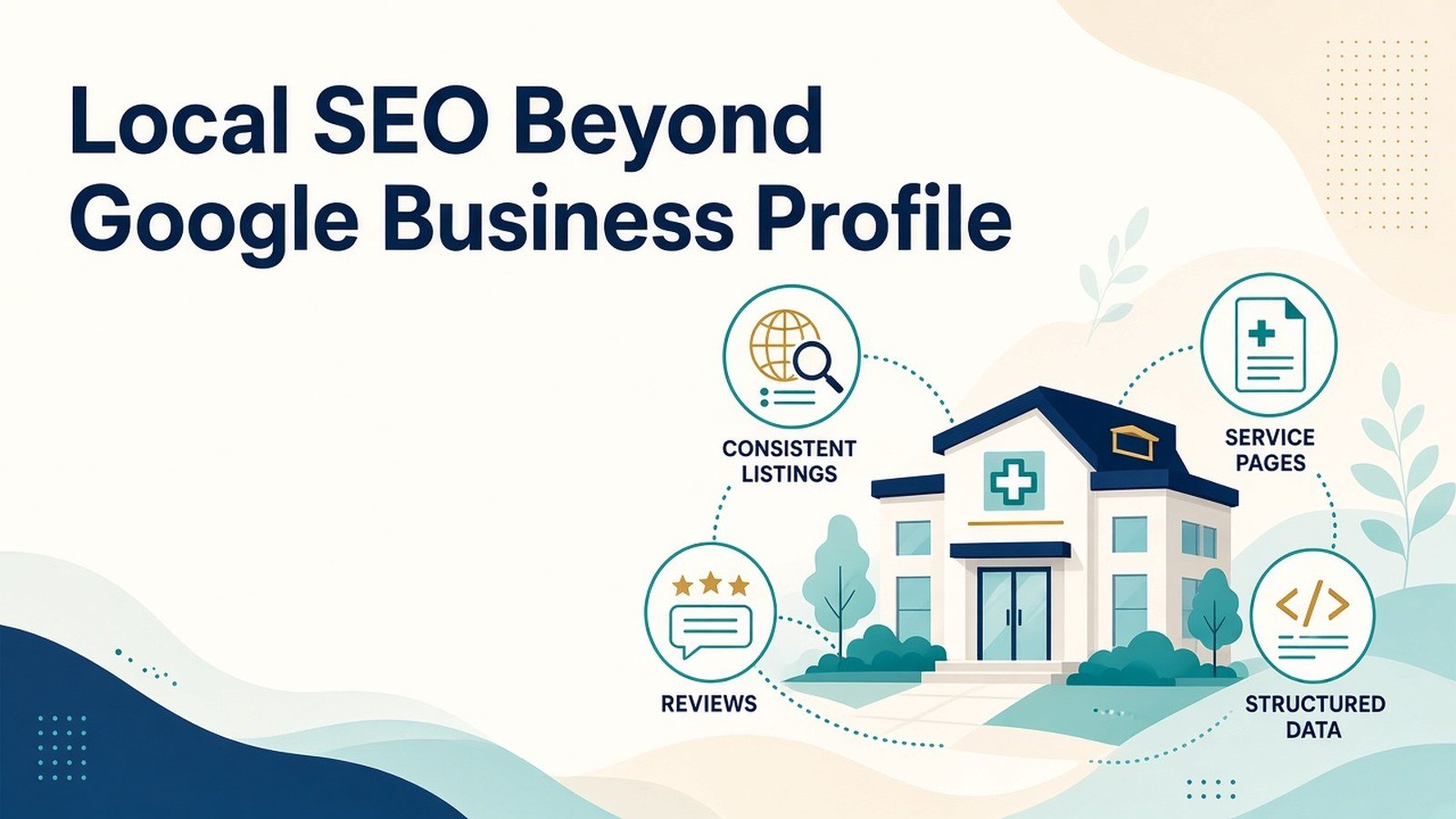
Most clinics treat their Google Business Profile as the whole of local SEO. Fill in the hours, upload a few photos, ask some patients for reviews, done. The profile matters, but it is only one input. If you want
local search visibility beyond Google Business Profile
, you have to look at what Google collects from everywhere else: your website, the directories that list you, the hospitals where you consult, and how your name, address, and phone number appear across all of them.
This guide covers those other signals, which ones a doctor or practice manager can realistically control, and how to work on them without breaking India’s medical advertising rules.
Why does the profile alone stop working?
Picture a parent in Kolkata searching “paediatrician near me” late in the evening. Google shows three practices in the map pack. Yours may have a complete profile and still miss out, because the others give Google more reasons to trust them. Their websites have a page for each service. Their details match on Practo, Justdial, and the hospital site. A local news portal quoted one of them during a dengue awareness drive.
None of those lives inside the profile. That is the gap most clinics leave open.
The principles Google says it uses
Google’s own help documentation names three factors for local results: relevance, distance, and prominence. Distance you cannot change. The other two you can influence.
Relevance is how closely your information matches what someone searched for. Prominence is how well known the practice is, and Google says it builds that picture partly from information across the web, such as links, articles and directories.
Reviews count too: Google says more reviews and better ratings will probably help. It adds that a business’s position in regular web results counts, so ordinary SEO practice applies to local results as well. That last point is the one doctors tend to miss. Your website is not separate from your map ranking. It feeds it.
A step-by-step method for doctor local search optimization
Work through these in order. Each step makes the next one more useful.
- Fix your NAP everywhere. List every place your practice name, address, and phone number appear: Practo, Justdial, hospital consultant pages, specialty society listings, social profiles. Make them identical, down to “Flat 2B” versus “2B”. Old numbers and former chamber addresses are the usual culprits.
- Build one page per service and location. A cardiologist who offers ECG, echo, and TMT should have a plain-language page for each. If you consult at two chambers, each deserves its own page with address, timings, and directions. Do not create pages for areas you do not actually serve.
- Add structured data. Schema markup such as Physician or MedicalClinic tells search engines what your pages describe. Ask your developer to include address, hours, and specialty, matching exactly what the page says.
- Earn local mentions. Health camps, talks at schools or resident associations, and quotes in regional or Bengali-language health columns create the citations Google describes under prominence. Pursue the ones that come from real activity.
- Keep the site fast on phones. Most searches for doctor local search optimization happen on a mobile. A slow page with a tiny phone number undoes everything above.
- Collect reviews honestly, across platforms. Invite feedback on Google and on the directories your patients already use. Never buy, script, or filter reviews.
Illustrative checklist (not a client result)
The template below is for a hypothetical two-chamber dermatology practice. It shows the shape of a quarterly audit, not outcomes from any real clinic.
| Signal | What to check | Owner |
|---|---|---|
| NAP consistency | Same name, address, and phone on every listed platform | Practice manager |
| Service pages | One page each for acne, pigmentation, hair loss | Web team |
| Location pages | A separate page per chamber with map and timings | Web team |
| Schema | MedicalClinic markup validates without errors | Developer |
| Local mentions | At least one genuine community or press mention per quarter | Doctor |
| Reviews | Replies within a week, with no patient details | Front desk |
Common mistakes, limits and compliance
The most common mistake is chasing volume: dozens of thin directory listings, area pages for neighbourhoods the clinic never sees patients from, or a sudden burst of reviews. These usually create inconsistencies rather than trust.
Compliance is the bigger risk. In October 2026, the National Medical Commission issued guidelines on ethical advertising and public communication for doctors and hospitals. They bar procuring fake reviews, ratings, or followers, and manipulating search rankings.
They also expect healthcare platforms that host doctors to prohibit paid ranking, so a paid “featured” slot on a directory is a weak thing to build a strategy around. Claims such as “guaranteed cure” or “100% success” are out. The guidelines also say a patient’s consent does not make a promotional testimonial acceptable, which rules out before-and-after galleries and success stories as ranking tactics.
Privacy applies to every reply you post. Never confirm that a reviewer is your patient or mention their condition, even when answering criticism. The Digital Personal Data Protection Rules, notified in November 2025, add obligations around how practices handle personal data. Take legal advice for your own setup; this article is marketing guidance, not legal or medical advice.
And nobody can promise you a map pack position. Google states plainly that you cannot pay for or request a better local ranking.
How to measure progress and decide what’s next?
Check monthly, but judge trends over a quarter rather than week to week.
- In Business Profile performance data, watch searches, calls, and direction requests.
- In Search Console, filter queries that contain your area names or “near me” to see whether service pages appear for local terms.
- Ask the front desk to note how each new patient found you.
- Re-run the NAP audit every quarter, because directory data drifts.
If impressions rise but calls do not, the problem is usually on the page: unclear timings, a hidden phone number, or a confusing booking step. If impressions stay flat, go back to relevance and prominence. Better medical practice local rankings tend to follow steady, unglamorous work on those two.
Final Words
Local SEO healthcare work reaches well past the Business Profile. Consistent listings, clear service and location pages, structured data, genuine community mentions, and honest reviews all feed the signals Google says it uses.
Done within NMC rules, they make a practice easier to find for the patients it actually serves. If you only do one thing this month, start with the NAP audit: it costs nothing, and most practices skip it.
For more on how these pieces fit a clinic’s wider plan, the
Local SEO for doctors page
at Doctors Branding Agency sets out the service in detail.
Keep reading
More from the Doctors Branding blog
-
How to Improve Internal Linking on a Medical Website?
A practical medical website internal linking method: audit orphan pages, build speciality clusters, set link rules, and check patients can...
Read article → -
Local SEO for Diagnostic Centres and Pathology Labs
Practical local SEO for diagnostic centres: fix Google profiles, build unique lab pages, keep details consistent, and measure results for...
Read article → -
How to Optimise Doctor Profile Pages for Search and Trust?
A doctor profile SEO guide covering what to include on each page, Physician schema, NMC-compliant wording, and a clear path...
Read article →
Want this kind of thinking applied to your practice?
Start with a conversation about where your doctor, clinic or hospital marketing stands today.