
Local SEO for Diagnostic Centres and Pathology Labs
Practical local SEO for diagnostic centres: fix Google profiles, build unique lab pages, keep details consistent, and measure results for each branch.
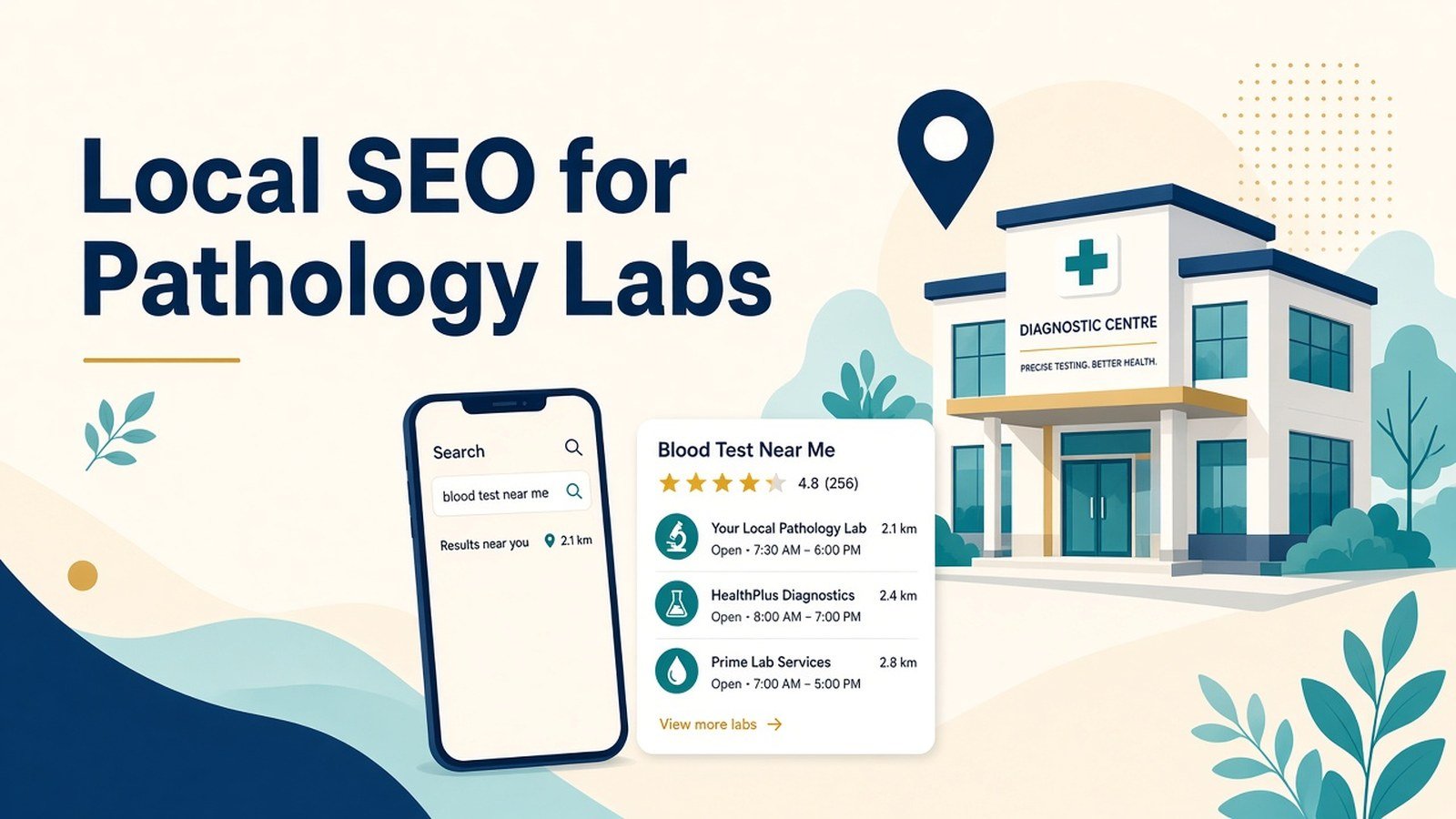
Someone wakes up with a doctor’s prescription for a lipid profile and a thyroid panel. They don’t search for your brand name. They type “blood test near me” or “pathology lab open now” into their phone, glance at the map, and call whichever lab looks reliable, close, and open.
Local SEO for diagnostic centres is the work of making sure your lab is one of the options people see in that moment, and that the information they find is accurate enough to act on. It covers your Google Business Profile, your location pages, and the trust signals around them. Nothing here guarantees a ranking position. What it does is remove the reasons a nearby patient might skip past you.
Why local search matters more for labs than for most clinics?
Patients will travel for a specialist. A routine blood test is different. Convenience drives it: distance, opening time, whether fasting samples are taken early, whether home collection is available, and whether the report arrives on WhatsApp or email.
That makes pathology lab local search unusually sensitive to practical details. A patient who arrives at 7 a.m. for a fasting sample and finds the shutter down won’t come back. If your collection centre in Salt Lake isn’t on the map at all, the patient books with the chain down the road.
The principles that decide local visibility
Google says local results are mainly based on three factors: relevance, distance and prominence. Translated for a diagnostic centre:
- Relevance is whether your listing and website clearly match what the person searched for. A profile that only says “diagnostic centre” without mentioning the tests, imaging services, or home collection you actually offer gives Google less to match against.
- Distance is how far you are from the searcher or the location they named. You can’t change your address, but you can make sure every genuine location has its own accurate presence.
- Prominence is how well known and trusted you are. Reviews, mentions on reputable local sites, and the overall quality of your website feed into it.
There is also a fourth, quieter principle: accuracy. Google’s guidelines for business profiles require a real address where customers are served in person during stated hours, and a business name that matches your signage. Breaking those rules can get a listing suspended, which wipes out the visibility you worked for.
A step-by-step method for diagnostic centre Google Maps SEO
Audit what already exists
Search for each of your locations on Google Maps to start working on diagnostic centre Google Maps SEO. Look for duplicate listings, old addresses, closed branches still showing as open, and listings created by former staff. Claim or request ownership where needed.
Decide which locations deserve a profile
One profile per physical location where patients are served in person during posted hours. A staffed collection centre usually qualifies. A home-collection-only operation with no walk-in counter should be set up as a service-area business with its address hidden. A tie-up desk inside someone else’s clinic, without your own staff or signage, generally shouldn’t have its own listing.
Fill in the profile properly
Use your real business name, with no keywords like “Best Blood Test Lab” added to it. Choose a primary category that describes the core service (for example, “Medical laboratory” or “Diagnostic center”) and add secondary categories only where they’re true. Enter accurate hours, including Sunday and early-morning sample timings, and update them before festival holidays. Add services, verifiable accreditation details, and real photos of the collection area.
Build lab location pages on your website
Each branch needs its own page with a unique address, phone number, hours, a map, the tests or scans available at that branch, parking or landmark directions, and home collection coverage. Link each Google Business Profile to its matching location page rather than to your homepage. Don’t clone one page 15 times and swap the area name; that’s thin content.
Keep your details consistent elsewhere
Your name, address, and phone number should match across health directories, Justdial, Practo-style listings, insurer and TPA network lists, and social profiles.
Ask for reviews in a compliant way
Ask every patient, not just the ones you expect to be happy. Don’t offer discounts for reviews and don’t filter who gets the request. When replying, never confirm that the reviewer is a patient or mention any test, result, or condition, even if they did.
Illustrative example: a two-branch lab in Kolkata
This is a hypothetical scenario for explanation, not a client case.
Imagine a NABL-accredited lab with a main centre in Ballygunge and a smaller collection centre in New Town, plus home collection across South Kolkata. An audit finds the New Town centre has no listing, the Ballygunge profile lists the phone number of a staff member who left, and the website has one “Contact” page with both addresses.
A reasonable plan would be to create and verify a New Town profile, correct the Ballygunge phone number, and build two location pages, each listing the tests performed or collected there and the early-morning fasting slots. Home collection areas belong in the Ballygunge profile’s service list, not in separate listings per neighbourhood.
Quick checklist for each location
- One verified profile per real, staffed location
- Business name matches signage exactly
- Hours include fasting-sample and holiday timings
- Profile links to its own location page
- Location page lists services available at that branch
- Name, address and phone match across directories
- Review requests sent to all patients, replies contain no health details
Common mistakes, limits and compliance points
The most frequent mistake is keyword stuffing the business name. It breaks Google’s guidelines and invites suspension. Close behind are fake listings for areas where you only offer home collection, and location pages that differ by a single word.
On privacy, India’s Digital Personal Data Protection Rules were notified in November 2025, with consent and notice obligations phasing in by May 2027. Online booking forms, WhatsApp report delivery, and review-request messages all involve personal data, so get legal advice on consent wording and avoid putting test names or patient details into tracking tools.
Keep marketing copy separate from medical guidance: a location page can say a lipid profile requires fasting if that’s your lab’s instruction, but it shouldn’t interpret results or suggest which tests someone needs.
Local SEO also has limits: a competitor closer to the searcher may still appear first.
How to measure progress and decide what to do next?
Track calls, direction requests, and website clicks per location in Google Business Profile performance data, month on month. In Google Search Console, filter queries containing “near me”, your area names and test names, and check which lab location pages are earning impressions.
If impressions are low, look at categories, services, and relevance. If impressions are healthy but calls are low, look at your photos, reviews, and hours. If clicks reach the website but bookings don’t follow, the location page needs clearer next steps.
Summary
Local SEO for diagnostic centres comes down to being accurate, being present at every genuine location, and making it easy for a nearby patient to choose you. Start with an audit, fix profiles, build distinct location pages, then measure each branch separately. For a broader look at how local search fits with other channels for labs and clinics, the Doctors Branding Agency clinic and diagnostic marketing page sets out the related service in more detail.
Keep reading
More from the Doctors Branding blog
-
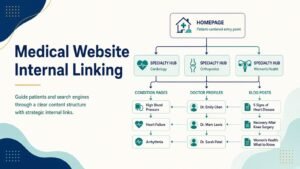
How to Improve Internal Linking on a Medical Website?
A practical medical website internal linking method: audit orphan pages, build speciality clusters, set link rules, and check patients can...
Read article → -
Local SEO Beyond Google Business Profile: Other Signals Doctors Can Manage
Local SEO beyond Google Business Profile: other signals doctors can manage, from consistent listings and service pages to reviews and...
Read article → -
How to Optimise Doctor Profile Pages for Search and Trust?
A doctor profile SEO guide covering what to include on each page, Physician schema, NMC-compliant wording, and a clear path...
Read article →
Want this kind of thinking applied to your practice?
Start with a conversation about where your doctor, clinic or hospital marketing stands today.