
How to Optimise Doctor Profile Pages for Search and Trust?
A doctor profile SEO guide covering what to include on each page, Physician schema, NMC-compliant wording, and a clear path for patients to book.
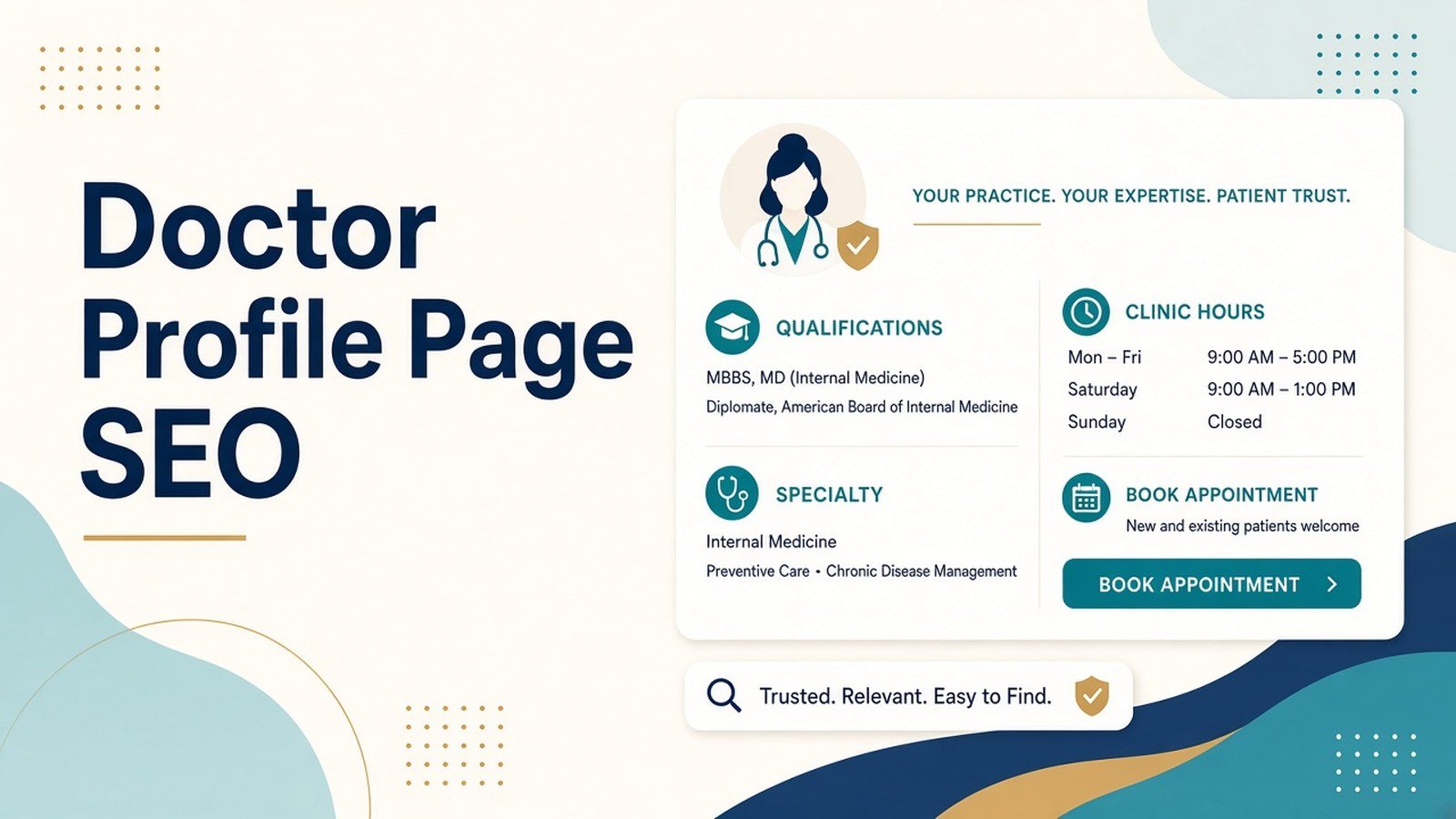
An SEO-friendly doctor profile page clearly states who the doctor is, what they treat, where and when they practise, and how a patient can book. It should include the doctor’s full name, recognised qualifications, State or National Medical Register (SMR/NMR) registration number, specialty, conditions and procedures covered, clinic locations, consultation timings and fees, and a booking route.
Add Physician structured data, and keep the wording factual. In India, that matters for trust and also for compliance with the National Medical Commission’s (NMC) advertising guidelines issued in October 2026.
Why do profile pages drive more appointments than you think?
Ask a practice manager which page matters most, and they’ll usually say the homepage. Look at the search data and the answer is often different. Many patients search by name (“Dr Ananya Sen cardiologist”) or by need plus place (“ENT doctor near Behala”). Both kinds of search tend to land on a doctor’s profile.
That page then has one job: help a worried person decide whether this is the right doctor. Too many clinic sites give them a stock photo, two lines of text, and a phone number that rings out. Google has little to understand, and the patient has little to trust.
Google treats health content as “Your Money or Your Life” territory, where its quality raters look closely at experience, expertise, authoritativeness, and trust. A thin profile tells search engines and patients almost nothing about any of those.
The principles behind a strong doctor profile
Three ideas shape everything that follows.
- Facts, not adjectives. Patients and search engines both respond to specifics: degrees, the institutions they came from, years in practice, procedures performed, languages spoken. “Highly experienced and caring” adds nothing that can be checked.
- One doctor, one page, one URL. Each practitioner needs their own indexable page, not a shared “Our Team” carousel. Keep the same name format on the website, the Google Business Profile, and directory listings.
- Compliance is part of trust. The NMC’s Guidelines on Ethical Advertising and Public Communication (October 2026) say a hospital directory that lists recognised qualifications, specialties, registration details and availability is patient information, not paid promotion. Superlatives, testimonials and success rates fall on the other side of that line.
Step-by-step: building or fixing a profile page
Step 1: Audit what exists. List every doctor, their current URL, and what’s missing. In Search Console, check which profiles get impressions for name searches and which get none.
Step 2: Collect verified information. Get the doctor’s credentials page from the doctor or from HR records, not from an old brochure. Confirm the registration number, the council, qualifications with institutions and years, memberships, languages, OPD timings for each location, and fees if the practice chooses to publish them
Step 3: Write the page around patient questions. Patients want to know what this doctor treats, whether they can see them this week, where to go, and what it costs. Use H2s that answer those questions directly, such as “Conditions treated”, “Clinic timings and locations” and “How to book”.
Step 4: Add structured data. Use schema.org’s Physician type (or Person, linked to the clinic’s MedicalClinic markup) with name, medicalSpecialty, address, openingHours, and sameAs links to official listings. Don’t add star-rating markup for reviews collected on your own site. Google’s review snippet guidelines make pages with LocalBusiness or Organization markup ineligible for self-serving review stars.
Step 5: Connect the page. Link each profile from its specialty and location pages, and link back from the profile to those pages. Where a doctor has written helpful articles, link to them under a heading such as “Articles by Dr Sen”.
Step 6: Review on a schedule. Timings, fees, and locations change. Set a quarterly review, so the page never shows a clinic the doctor left six months ago.
Template: a compliant profile page structure
This is an illustrative template using a fictional doctor. It is not a real practitioner or a client result.
Dr Ananya Sen, MBBS, MD (Medicine), DM (Cardiology), Consultant Cardiologist, [Clinic name], Salt Lake, Kolkata, WBMC Registration No.: [number]
| Section | What to include |
|---|---|
| Summary (2–3 lines) | Specialty, years in practice, main areas of work in plain language |
| Qualifications | Degree, institution, and year for each qualification |
| Conditions and procedures | Hypertension, heart failure, echocardiography, and so on, each linking to the relevant specialty page where one exists |
| Clinic locations and timings | Each location’s address, days, and OPD hours |
| Consultation fees | Stated as fact, if the practice publishes them |
| Languages | Bengali, Hindi, English |
| Memberships | Professional bodies, stated without ranking claims |
| How to book | Phone, booking link, what to bring |
| Last reviewed | Date and who verified the information |
Add a clear, professional headshot only after checking how your practice interprets the NMC’s restriction on promotional use of doctors’ photographs. A plain photo in a directory is very different from a portrait on a billboard-style banner.
Before and after: rewriting a weak bio (fictional example)
Weak: “Dr Sen is one of the best and most trusted cardiologists in Kolkata, with thousands of happy patients.”
Stronger: “Dr Ananya Sen is a consultant cardiologist with 14 years of clinical practice. She sees adults with hypertension, heart failure and rhythm disorders, and performs echocardiography and stress testing. She consults in Bengali, Hindi and English at the Salt Lake clinic on Mondays, Wednesdays and Fridays.”
The second version is longer, but every claim in it can be checked. It also gives search engines the conditions, procedures, and location that patients actually search for.
Common mistakes and compliance considerations
- Superlatives and rankings. “Best cardiologist in Kolkata” or “No. 1 specialist” isn’t allowed under the NMC guidelines unless it can be independently verified. It also reads as marketing, which lowers trust.
- Testimonials and before-and-after images. The guidelines prohibit using patient testimonials, success stories, and before-and-after photos for promotion. Take these off profile pages, including embedded review widgets.
- Success rates and patient counts. “5,000 successful surgeries” falls into the same restricted category. Describe procedures the doctor performs, not tallies.
- Unlabelled AI content. If AI helps draft a bio, a person must check every fact against records. The guidelines require permitted AI-generated content to be clearly labelled, and they bar synthetic endorsements.
- Duplicate bios. Copying the same paragraph to a hospital site, Practo, and your own page gives search engines no reason to prefer yours. Write a fuller version for your own website.
- Patient information. Never mention identifiable patients or cases. Anonymised material belongs in teaching or scientific contexts, not on a promotional page.
Responsibility doesn’t shift to the agency. The NMC guidelines state that using a third-party platform or agency doesn’t remove a doctor’s responsibility for medical practice website content they authorised. Have the doctor sign off on every profile. This article is marketing guidance, not legal or medical advice, so take compliance questions to qualified counsel.
Measuring progress and deciding what to do next
Track these every month for each profile:
- Search Console impressions and clicks for the doctor’s name and for “specialty + area” searches.
- Average position for name searches. A doctor’s own profile should normally appear near the top for their full name.
- Engagement actions in analytics: clicks on the call button, booking link, and directions.
- Rich result status in Search Console’s enhancements reports, to catch structured-data errors.
Then decide. A profile with low impressions usually needs better internal links and a fuller summary. One with impressions but few clicks needs a sharper title and meta description. One with clicks but no booking actions needs clearer timings and a more visible booking route. Fix one thing, wait four to six weeks, then review again. None of this guarantees more appointments, but it removes the most common reasons patients leave.
Final Thoughts
A good doctor profile page SEO answers patient questions with verified facts: who the doctor is, what they treat, where and when they practise, and how to book. Give every doctor their own page, add Physician schema, link profiles into specialty and location pages, and keep the wording within the NMC’s advertising guidelines. For practices reviewing their whole site, Doctors Branding Agency’s Healthcare SEO and website design pages explain how profile pages fit into a wider search and site structure.
Action checklist for each doctor profile
- Own indexable URL, with the name format matching Google Business Profile
- Full name, qualifications with institutions, and SMR/NMR registration number
- Specialty, plus conditions and procedures in plain language
- Locations, OPD timings and fees (if published)
- Clear booking route above the fold on mobile
- Physician schema, with no self-serving review stars
- No superlatives, testimonials, before-and-after images or success counts
- Any AI-assisted text fact-checked and labelled where required
- Linked from specialty and location pages
- Doctor sign-off and a “last reviewed” date
Frequently asked questions
What should a doctor profile page include?
Full name, recognised qualifications, registration number, specialty, conditions treated, locations, timings, fees if published, languages, and a clear way to book.
Can doctors in India show patient testimonials on their website?
The NMC’s October 2026 advertising guidelines prohibit using patient testimonials, success stories, and before-and-after photos for promotion.
Does schema markup help a doctor profile rank?
Physician structured data helps search engines understand the page for physician bio SEO. It doesn’t guarantee rankings or rich results.
Should every doctor have a separate page?
Yes. A separate, indexable page for each doctor lets the profile appear for name searches and carry its own specialty details.
Is it necessary to show the registration number?
The NMC guidelines expect electronic posts by or about a doctor to disclose name, qualifications, registration status, and SMR/NMR number, so include it on the profile.
Keep reading
More from the Doctors Branding blog
-
How to Improve Internal Linking on a Medical Website?
A practical medical website internal linking method: audit orphan pages, build speciality clusters, set link rules, and check patients can...
Read article → -

Local SEO Beyond Google Business Profile: Other Signals Doctors Can Manage
Local SEO beyond Google Business Profile: other signals doctors can manage, from consistent listings and service pages to reviews and...
Read article → -

Local SEO for Diagnostic Centres and Pathology Labs
Practical local SEO for diagnostic centres: fix Google profiles, build unique lab pages, keep details consistent, and measure results for...
Read article →
Want this kind of thinking applied to your practice?
Start with a conversation about where your doctor, clinic or hospital marketing stands today.