
Healthcare Content Pruning: When to Update, Merge or Remove Pages
A practical guide to healthcare content pruning: when to update, merge or remove medical pages, and how to measure impact without losing useful content.
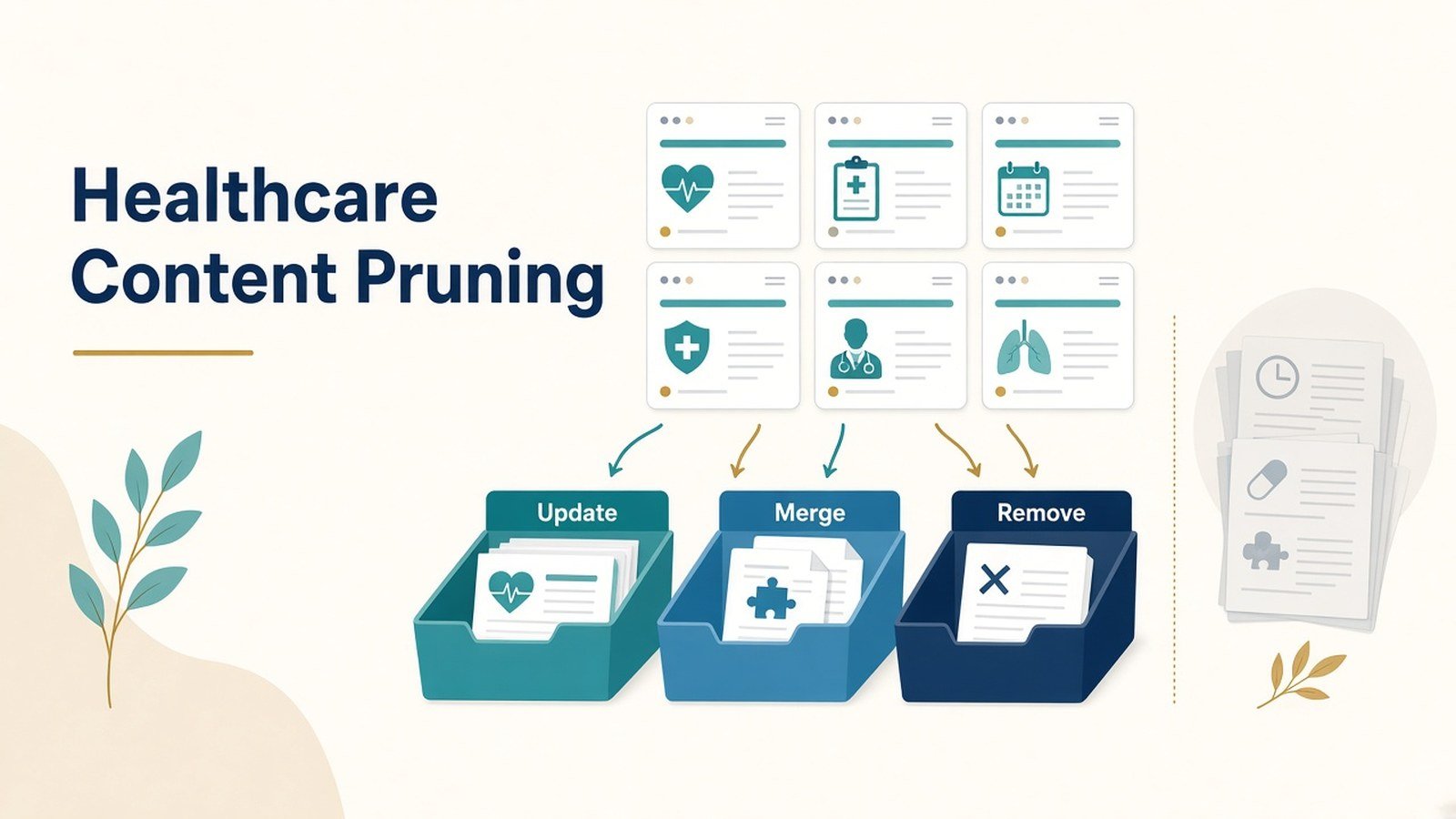
A healthcare website can accumulate years of blog posts, treatment pages, service descriptions, and educational resources. Some continue to attract relevant visitors, while others become outdated, overlap with newer articles, or no longer match what patients and caregivers are searching for. Keeping every page indefinitely is not necessarily the best approach to healthcare SEO.
The challenge is deciding which pages deserve attention, which should be consolidated, and which can be removed without sacrificing useful information or search visibility. A structured healthcare content audit helps healthcare business leaders, clinic managers, and marketing teams make these decisions using evidence rather than assumptions.
Content pruning is not simply deleting pages with low traffic. It is the process of improving a website’s overall usefulness by evaluating the accuracy, relevance, performance and purpose of its existing content. For healthcare organisations, that process requires particular care because medical information can influence decisions about seeking care, understanding symptoms and choosing services.
The right approach is to protect trustworthy information, address content gaps and make each page serve a clear purpose.
What Is Healthcare Content Pruning, and Why Does It Matter?
Healthcare content pruning involves reviewing existing website pages and deciding whether to update, merge, redirect, or remove them. The objective is to maintain a useful, accurate, and well-organised website rather than maximise the number of published URLs.
Consider a clinic that has published several articles about diabetes management over five years. One explains dietary basics, another discusses lifestyle changes, and a third covers the same general advice with older statistics. If all three target similar searches and provide little distinctive value, visitors may struggle to identify the most useful resource.
However, overlap alone does not mean every page should disappear. Each article might address a different audience, clinical question, or stage of the patient journey. The decision depends on its purpose and value.
The Three Main Decisions: Update, Merge, or Remove
Every page should be evaluated individually. A consistent decision framework makes the process easier to manage and reduces the risk of deleting content that still serves patients.
Update pages that remain useful
Updating is generally appropriate when a page addresses a valid topic but contains outdated information, incomplete explanations, weak structure, or missing context.
For example, a hospital’s article about preparing for a diagnostic appointment may still match patient needs, but its preparation instructions, service details or booking process may have changed.
A refresh could involve:
- Verifying clinical statements with a suitably qualified reviewer.
- Updating references, statistics and publication details where necessary.
- Replacing discontinued service information.
- Answering questions that the existing article overlooks.
- Improving headings, readability and internal links.
- Checking that the page reflects the clinic’s current services and location.
A medical content refresh should improve the information itself, not merely change the publication date or add keywords. Medical accuracy takes priority over cosmetic optimisation.
Merge pages that serve substantially the same purpose
Merging is useful when multiple URLs address nearly identical questions, and none provides a sufficiently distinct reason to remain separate.
This is a common response to duplicate healthcare content, although duplicate content can take different forms. Some pages may be near-identical copies; others may contain overlapping information written for slightly different searches.
Before merging, compare each page’s audience, intent, unique information, backlinks, organic queries, and conversion role. Then create one comprehensive resource that preserves the useful material from the relevant pages.
Remove pages only when there is a defensible reason
Removal may be appropriate for content that is obsolete, redundant, misleading, irrelevant to the organisation, or no longer useful to visitors.
Examples include a discontinued event page with no lasting reference value, an outdated announcement, or a thin article that adds nothing beyond a more authoritative resource.
Before deleting a URL, check whether it receives organic visits, has valuable backlinks, supports another page through internal links, or serves users who arrive through bookmarks and external referrals.
A Step-by-Step Framework for a Healthcare Content Audit
A reliable audit combines search data, editorial judgement and clinical oversight. The following process can help marketing teams organise the work.
Step 1: Build a complete inventory of existing pages
Start by collecting URLs from the website’s XML sitemap, content management system and available crawling tools. Include blog posts, service pages, location pages, condition guides, and other indexable resources.
For each URL, record:
- Page title and content type.
- Original publication and last substantive review dates.
- Main topic and intended audience.
- Primary search intent.
- Clinical reviewer or content owner, where applicable.
- Indexing status and current URL destination.
A complete inventory reduces the likelihood of overlooking older pages that remain accessible through internal links but no longer appear in the main navigation.
Step 2: Gather performance and quality evidence
Use Google Search Console, web analytics, and a site crawler to understand how pages perform. Review an appropriate period, such as the previous 12 months, and compare it with an earlier period where seasonality and data availability permit.
Useful indicators include:
- Organic clicks and impressions.
- Search queries and average positions.
- Relevant referral traffic and engaged visits.
- Meaningful actions, such as appointment enquiries.
- Referring domains and valuable external links.
- Internal links and crawl or indexing issues.
Low traffic is a reason to investigate, not an automatic reason to delete. A specialist page may receive limited visits but provide essential information for a small patient population. Similarly, a page with strong traffic may still need urgent clinical corrections.
Step 3: Assess search intent and topical overlap
Compare pages that target similar topics. Ask whether each one answers a distinct question or simply repeats information available elsewhere.
Search results can help reveal whether users expect a broad educational guide, a local service page, a specialist explanation, or a booking-oriented resource. Review actual search queries alongside the page content rather than relying solely on keyword similarity.
Content decay SEO describes a decline in a page’s organic search performance over time. It may result from outdated information, changing search intent, stronger competing content, technical problems, or reduced relevance. The cause should be investigated before deciding that pruning is necessary.
Step 4: Prioritise the work
Not every page needs immediate attention. Prioritise content with serious accuracy concerns, important service information, substantial overlap or a clear opportunity to improve user experience.
A practical order is:
- Correct potentially unsafe or materially outdated medical information.
- Review high-value service and condition pages.
- Resolve substantial duplication and competing pages.
- Refresh declining content with a clear improvement opportunity.
- Evaluate low-value pages for removal.
This sequence balances editorial risk, patient needs, and available resources.
Step 6: Implement changes carefully
Once the decision is approved, document the original URL, action taken, destination URL where applicable, and reason for the change.
For merged content, publish the consolidated page before redirecting the retired URLs. Update internal links to point directly to the preferred destination, check canonical tags, and confirm that the final page returns the correct HTTP status.
Google recommends permanent server-side redirects, such as HTTP 301 or 308, when a page has genuinely moved to a new URL. Redirects should lead to relevant replacement content rather than unrelated destinations.
Step 7: Review the results
After implementation, monitor the updated or consolidated URLs and compare their performance with the baseline. Allow sufficient time for crawling, indexing, and normal search fluctuations before concluding.
Check for broken links, redirect errors, unexpected traffic losses, and changes in relevant search queries. If the new page performs poorly, investigate the cause rather than immediately reversing the decision.
Common Mistakes Healthcare Teams Should Avoid
Even a well-intentioned pruning exercise can create problems when the team focuses exclusively on SEO metrics.
Deleting pages solely because they receive little traffic. A resource may support an uncommon condition, a specialist service, or an important patient question. Evaluate its purpose before removing it.
Merging pages based only on similar keywords. Two articles can share terminology while addressing different needs. Review the actual search intent, audience, and clinical scope before consolidating them.
Changing dates without making substantive improvements. A newer date does not make inaccurate or incomplete information more useful. Google’s guidance emphasises helpful, reliable, people-first content rather than changes made primarily to create an appearance of freshness.
Redirecting every deleted page to the homepage. An unrelated destination may frustrate visitors and fail to provide the information they expected. Choose a replacement that closely matches the original page’s purpose.
Medical Accuracy, Privacy and Compliance Considerations
Healthcare content requires stricter editorial care than many general business topics. A page that appears outdated from an SEO perspective may still contain clinically important information that should be corrected rather than removed without review.
Establish a clear approval process for medical claims, treatment descriptions, and patient-facing instructions. Record the reviewer, review date and authoritative references where appropriate. Do not imply that marketing content substitutes for a clinician’s advice.
Protect patient-identifiable information throughout the audit. Website analytics, enquiry records and examples used for internal discussions should be handled according to applicable privacy requirements and organisational access controls. Never publish patient details, screenshots or case examples without a lawful basis and the necessary permissions.
For clinics operating in India, review applicable professional conduct, privacy and consumer-protection requirements, alongside relevant state or institutional rules. Requirements may differ according to the provider, service and information being published. Obtain qualified legal or compliance advice when a change involves sensitive claims, patient testimonials or regulated services.
Finally, check platform policies before making changes to business listings or other external profiles. Keep service descriptions, opening hours, and contact details consistent with the actual service offered. Editorial improvements should make information more trustworthy, not exaggerate clinical expertise or promise outcomes.
How to Measure Progress After Content Pruning?
A successful audit should be evaluated against the original problem, not simply the number of pages removed.
Google Search Console provides data on impressions, clicks, click-through rate, and average position. These metrics help teams examine search visibility and identify changes at the page and query level.
Track a balanced set of indicators:
- Search performance: Compare relevant clicks, impressions, and queries before and after the changes.
- Content quality: Confirm that medical information is accurate, references are current, and each page has a clear purpose.
- Technical health: Monitor redirects, broken links, indexing status, and sitemap accuracy.
- User engagement: Review meaningful engagement indicators available in the analytics setup, without treating any single metric as proof of content quality.
- Business relevance: Where measurement is configured appropriately, assess relevant appointment enquiries or service-page interactions without exposing patient information.
Compare equivalent periods where possible and account for seasonality, changes in service demand, website redesigns and broader search fluctuations. There is no universal recovery timeline, and pruning does not guarantee improved rankings or more appointments.
If performance declines after a merge, check whether the replacement preserves the useful information and search intent of the original pages. If an updated article attracts impressions but few clicks, review its title and search-result presentation. If the page is not being indexed, investigate technical and indexing issues before rewriting the entire article.
Conclusion
Healthcare content pruning works best as an ongoing editorial process, not a one-time deletion exercise. A structured healthcare content audit helps teams distinguish valuable resources from outdated information, unnecessary duplication, and pages that no longer meet patient needs.
Update content when its purpose remains relevant, merge pages when they genuinely overlap, and remove content only when there is a clear justification. Clinical accuracy, user intent, and technical implementation should guide every decision.
Healthcare organisations looking to integrate content reviews with their broader organic search strategy can explore the Healthcare SEO service page from Doctors Branding Agency for information about healthcare-focused search optimisation.
Keep reading
More from the Doctors Branding blog
-
How to Improve Internal Linking on a Medical Website?
A practical medical website internal linking method: audit orphan pages, build speciality clusters, set link rules, and check patients can...
Read article → -

Local SEO Beyond Google Business Profile: Other Signals Doctors Can Manage
Local SEO beyond Google Business Profile: other signals doctors can manage, from consistent listings and service pages to reviews and...
Read article → -

Local SEO for Diagnostic Centres and Pathology Labs
Practical local SEO for diagnostic centres: fix Google profiles, build unique lab pages, keep details consistent, and measure results for...
Read article →
Want this kind of thinking applied to your practice?
Start with a conversation about where your doctor, clinic or hospital marketing stands today.