
Medical Schema Markup: What Doctors and Clinics Should Implement
Learn which medical schema markup doctors and clinics should implement, how to add it accurately, and how to check that it helps patients find the practice.
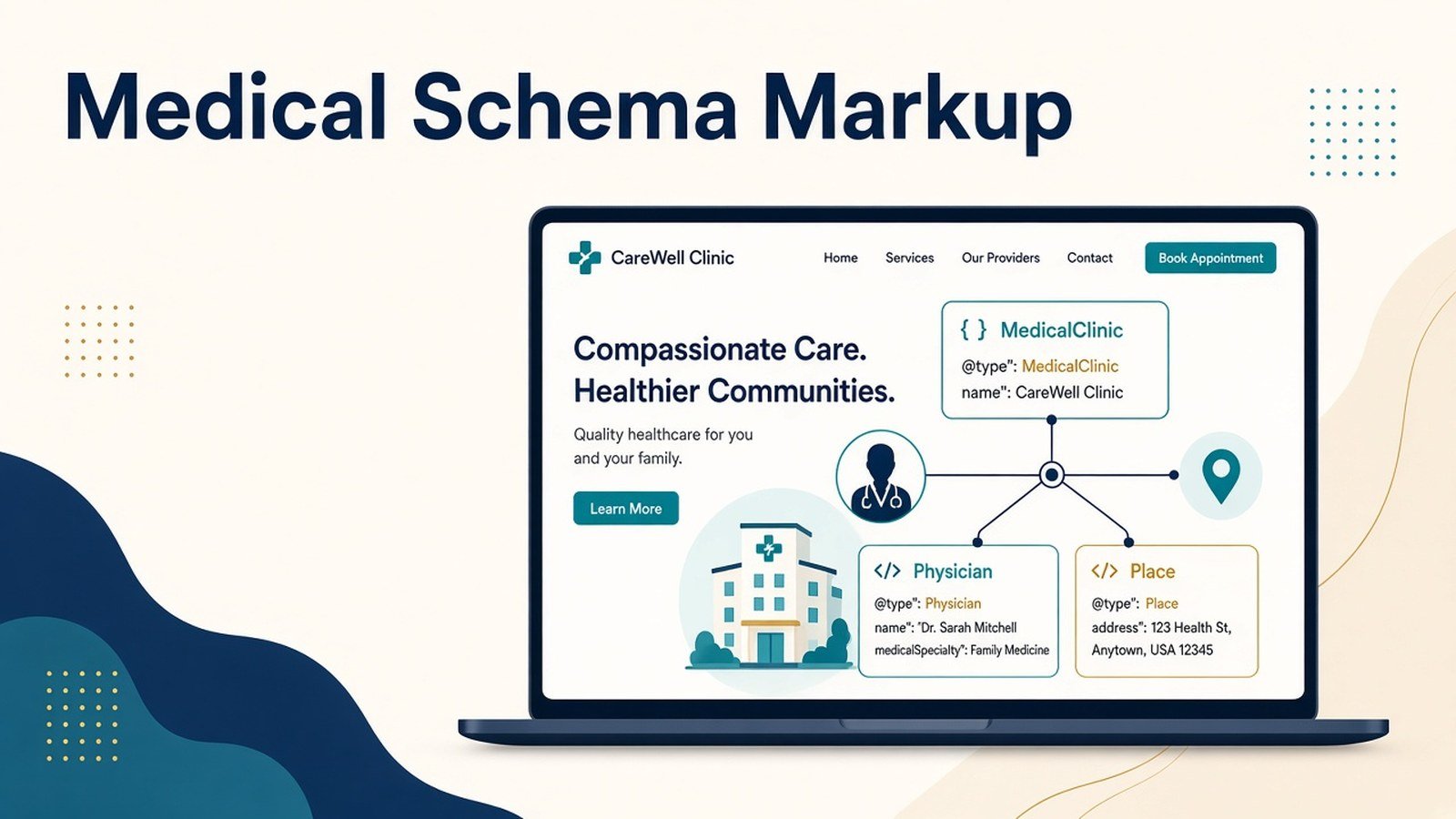
A healthcare website can contain accurate information about doctors, medical services, clinic locations, and appointment procedures, yet search engines may still need clearer signals to interpret how those details relate to one another. Medical schema markup helps address this challenge by adding structured information to a webpage in a format that search systems can process.
For doctors, medical practitioners, practice managers, and healthcare marketing teams, the key question is not how much markup to add. It is which types accurately describe the practice, the individual clinician, and the information published on each page.
A sensible implementation starts with the organisation’s identity, the clinicians who work there, and the services available. It then adds relevant page-level information and validates the result. Google’s documentation explains that structured data can help its systems understand page content, but valid markup does not guarantee enhanced search appearances or higher rankings. Google Search Central’s structured data guide provides the technical foundation.
Why Medical Schema Markup Matters for Healthcare SEO?
Healthcare websites often describe several connected entities: a medical practice, its individual practitioners, specialist services, educational articles, and physical locations. If these details are unclear or inconsistent, both visitors and search systems may find it harder to understand the relationship between them.
Structured data provides explicit labels for information already presented on a page. For example, it can identify a clinic’s name, address, contact details, specialty, and website. Separate markup can describe an individual practitioner and connect that person to the organisation where they practise.
This is particularly relevant to healthcare SEO, where accurate identity and service information supports a website’s broader technical and content foundations. However, schema is not a substitute for useful content, crawlability, a well-organised website, or trustworthy clinical information. It is one component of a wider optimisation process.
Which Schema Types Should Doctors and Clinics Implement?
The right choice depends on what the website represents. Schema.org defines healthcare-specific types, including Physician, MedicalClinic, and MedicalOrganization. These types describe entities; their availability in the vocabulary does not mean every type automatically qualifies a page for a special Google search feature.
1. MedicalClinic or MedicalOrganization
A clinic website should generally describe the organisation using the most specific applicable type. The Schema.org MedicalClinic type describes a healthcare facility, while MedicalOrganization is a broader type for medical organisations.
Relevant properties may include:
- name: the practice’s real name.
- url: the official website.
- address: the actual practice address.
- telephone: a current public contact number.
- openingHoursSpecification: accurate opening hours, where applicable.
- medicalSpecialty: the specialty or specialties genuinely provided.
- logo and image: relevant, accessible brand or location images.
Choose properties according to the practice’s real circumstances. Do not publish a residential address, unavailable service, or unverified opening time merely to make the markup appear more complete.
2. Physician Schema
The Physician type describes an individual physician or a physician’s office considered as a medical organisation. A dedicated clinician profile can include relevant information such as the doctor’s name, professional image, specialty, public contact details, and verified affiliations.
For a multi-doctor clinic, individual profile pages help distinguish practitioners rather than treating every clinician as one entity. Connect the doctor to the practice where appropriate, and ensure the relationship matches the information visible on the website.
Do not add qualifications, affiliations, or specialties that cannot be verified. Physician Schema should describe professional identity accurately, not strengthen credentials through unsupported claims.
3. WebPage and Article
General page types can help describe the purpose of individual URLs. A service page, for example, can be represented as a WebPage and connected to the organisation that provides the service.
Educational content may use Article or a more specific article type where appropriate. Include accurate titles, publication dates, authorship, and relevant images when those details are available and visible.
This information helps establish what a page is about. It does not guarantee that the page will appear in a particular search feature.
4. BreadcrumbList
BreadcrumbList can describe the hierarchy of a website, such as Home → Specialties → Cardiology. It is useful when the visible navigation genuinely reflects that hierarchy.
Google has specific requirements for breadcrumb structured data if a site seeks eligibility for breadcrumb search appearances. Review the applicable Google breadcrumb documentation before implementation.
5. FAQPage and Other Page-Specific Markup
Frequently asked questions can still be useful for patients when they address genuine concerns about consultations, preparation, or appointment procedures. However, adding FAQ schema should not be treated as a guaranteed way to earn expanded Google results. Google has withdrawn FAQ rich results from Search as of May 2026, according to its Search Central updates.
Choose structured data based on the page’s purpose and current platform guidance, rather than adding every available type.
How to Implement Healthcare Structured Data Step by Step?
A healthcare structured data implementation process helps prevent duplicate entities, inaccurate properties, and errors introduced by website plugins.
Step 1: Audit the existing website
List the homepage, clinic location pages, doctor profiles, service pages, and educational articles. Check whether the website already outputs schema through its theme, SEO plugin, booking system, or another integration.
This matters because adding a second markup block without reviewing the first can create conflicting descriptions of the same practice. Record the existing types, properties, and URLs before making changes.
Step 2: Match each schema type to the page
Use a simple decision framework:
- Homepage or About page: Describe the main medical organisation and its official identity.
- Individual doctor profile: Describe the practitioner and verified professional details.
- Clinic location page: Describe the specific physical location and its accurate contact information.
- Service page: Describe the page and connect it to the organisation providing the service.
- Educational article: Describe the article, its author, and publication details where appropriate.
- Page with hierarchical navigation: Consider breadcrumb markup that matches the visible breadcrumb trail.
A clinic with several branches should represent each location accurately rather than publishing one address across every branch page.
Step 3: Use JSON-LD where practical
JSON-LD is Google’s recommended structured-data format in most cases because it can be maintained separately from the visible HTML. It can be added through a suitable CMS plugin or a developer-managed implementation.
The markup must still describe the content of the relevant page. A plugin does not remove the need to review the output, and automatically generated fields should not be assumed accurate.
Step 4: Connect related entities consistently
Use stable, canonical URLs to identify the organisation and individual practitioners. Where appropriate, properties such as mainEntity, about, worksFor, or sameAs can help describe relationships or verified external identities.
For example, a doctor profile may identify the doctor and link the person to the clinic where they practise. A service page can identify the clinic as its provider. Use these properties only when they accurately represent the relationship.
Step 5: Validate before publishing
Google recommends testing structured data and checking how it sees the page. Use the Rich Results Test for supported Google rich-result features and the URL Inspection tool in Search Console to review crawling and indexing.
The Rich Results Test does not validate every possible Schema.org property or relationship. If necessary, use the Schema Markup Validator for broader vocabulary validation.
Correct syntax errors, review warnings, and confirm that the page can be crawled. After deployment, monitor Search Console for relevant reports and recheck the markup when the website changes.
Illustrative Example: A Multi-Doctor Clinic
Consider a hypothetical multispecialty clinic in Pune with separate profile pages for its cardiologist and dermatologist.
The clinic’s main page describes the organisation, its address, telephone number, and verified specialties. The cardiologist’s profile identifies the individual practitioner and their confirmed credentials. The dermatologist’s profile does the same for that practitioner. Each service page describes the relevant service and links it to the organisation.
This arrangement creates a clearer representation of the clinic and its practitioners than repeating one generic organisation block across every page without distinguishing the entities.
The implementation should reflect the clinic’s actual structure. If a practitioner works at several locations, the markup should not imply that the person is permanently based at only one location unless that is accurate.
Illustrative implementation checklist
- The organisation’s name, website, and address are correct.
- Each physical branch has accurate location information.
- Doctor profiles use verified professional details.
- Services described in markup are actually offered.
- Internal links and entity relationships are consistent.
- Structured data matches information visible to visitors.
- Markup has been tested before and after deployment.
This example demonstrates an implementation approach, not a claim of improved rankings, traffic, or patient numbers.
Common Mistakes and Compliance Considerations
One frequent mistake is using Physician for every healthcare business, regardless of whether the page represents an individual doctor, a clinic, or a hospital. Select the type that most accurately represents the entity.
Another is adding every possible property without verifying the underlying information. Empty fields, outdated telephone numbers, invented opening hours, and unconfirmed affiliations weaken data quality rather than improve it.
Avoid duplicating schema unnecessarily. Some themes and plugins generate organisation, website, or breadcrumb markup automatically. Review the rendered output and consolidate conflicting information where needed.
Google’s general structured data guidelines require markup to be relevant, accurate, and representative of the page. Marking up information that is hidden from users or creating misleading descriptions can make a page ineligible for rich results and may trigger a manual action.
Healthcare websites also need to consider privacy and professional responsibilities. Public professional information may be appropriate for a doctor profile, but patient names, medical records, appointment details, and other sensitive information should never be exposed through structured data. Review credentials and promotional claims carefully, and follow applicable Indian privacy requirements and professional rules.
Schema is technical metadata, not medical advice. It must not be used to imply that a practitioner is qualified for a specialty, that a treatment is suitable for a patient, or that a clinic offers a service unless the underlying facts support those statements.
How to Measure Progress and Decide What Comes Next
Evaluate implementation quality before expecting search performance to change. A practical review should cover three areas.
- Technical validity: Check for parsing errors, relevant warnings, duplicate markup, and changes introduced by plugins or website updates.
- Search accessibility: Use Search Console to verify that important pages can be crawled and indexed. Review applicable structured-data reports where Google provides them.
- Information consistency: Compare the website’s markup with visible page content, clinician profiles, location details, and relevant public business information. Correct inaccurate facts before adding more schema types.
Keep a record of the pages updated, the types implemented, validation results, and the date of each review. Recheck after redesigns, new branch launches, clinician changes, or updates to services.
If the markup is valid but search visibility remains unchanged, do not assume that more schema is the answer. Review page quality, search intent, internal linking, technical SEO, and the relevance of the information to prospective patients. Structured data is one part of a broader healthcare SEO programme, and its impact should be assessed alongside these other factors.
Conclusion
Medical schema markup helps doctors and clinics describe their organisation, practitioners, locations, and website content in a structured format. The most effective implementation is not the largest one; it is the one that accurately reflects the practice and remains consistent as the website evolves.
For further guidance, explore Doctors Branding Agency’s healthcare SEO and website design services. These resources can help healthcare teams consider structured data alongside content quality, site architecture, and technical accessibility, without treating schema as a guarantee of search rankings or enhanced results.
Keep reading
More from the Doctors Branding blog
-
How to Improve Internal Linking on a Medical Website?
A practical medical website internal linking method: audit orphan pages, build speciality clusters, set link rules, and check patients can...
Read article → -

Local SEO Beyond Google Business Profile: Other Signals Doctors Can Manage
Local SEO beyond Google Business Profile: other signals doctors can manage, from consistent listings and service pages to reviews and...
Read article → -
Local SEO for Diagnostic Centres and Pathology Labs
Practical local SEO for diagnostic centres: fix Google profiles, build unique lab pages, keep details consistent, and measure results for...
Read article →
Want this kind of thinking applied to your practice?
Start with a conversation about where your doctor, clinic or hospital marketing stands today.