
Medical Blog Topic Clusters: Organising Content by Specialty
Learn how medical blog topic clusters help clinics organise content by specialty, match patient intent, and connect articles to the right service pages.
A healthcare website can publish dozens of useful articles and still struggle to build meaningful organic visibility. One reason is that its content lacks a clear structure. A clinic might publish articles about diabetes, blood pressure, heart health, and nutrition without connecting them to a central specialty or service page. Each article may contain useful information, but visitors and search engines can find it difficult to understand how the content fits together.
This is where a structured medical blog content strategy becomes important.
Instead of treating every blog as an independent publishing task, healthcare marketing teams can organise articles into topic clusters based on medical specialties, patient questions and search intent. This approach creates a connected content library that supports website navigation, topical relevance and the discovery of relevant services.
For clinic managers and healthcare business leaders, the objective is not to publish more articles simply for the sake of activity. It is to make existing and future content more useful, organised and accessible.
Why Healthcare Websites Need Specialty-Based Content Organisation?
A multi-specialty clinic may provide cardiology, dermatology, gynaecology, orthopaedics and paediatrics services. Each specialty attracts different audiences, search queries and information needs.
However, a poorly organised blog can mix these subjects without a clear hierarchy. A visitor reading about knee pain might struggle to find related articles about arthritis, sports injuries or orthopaedic consultations.
Search engines also need to discover and interpret the relationships between pages. Google’s guidance explains that internal links help users and Google understand a website’s structure and discover other pages. A specialty-based structure helps address these challenges by grouping related articles and connecting them to relevant service pages.
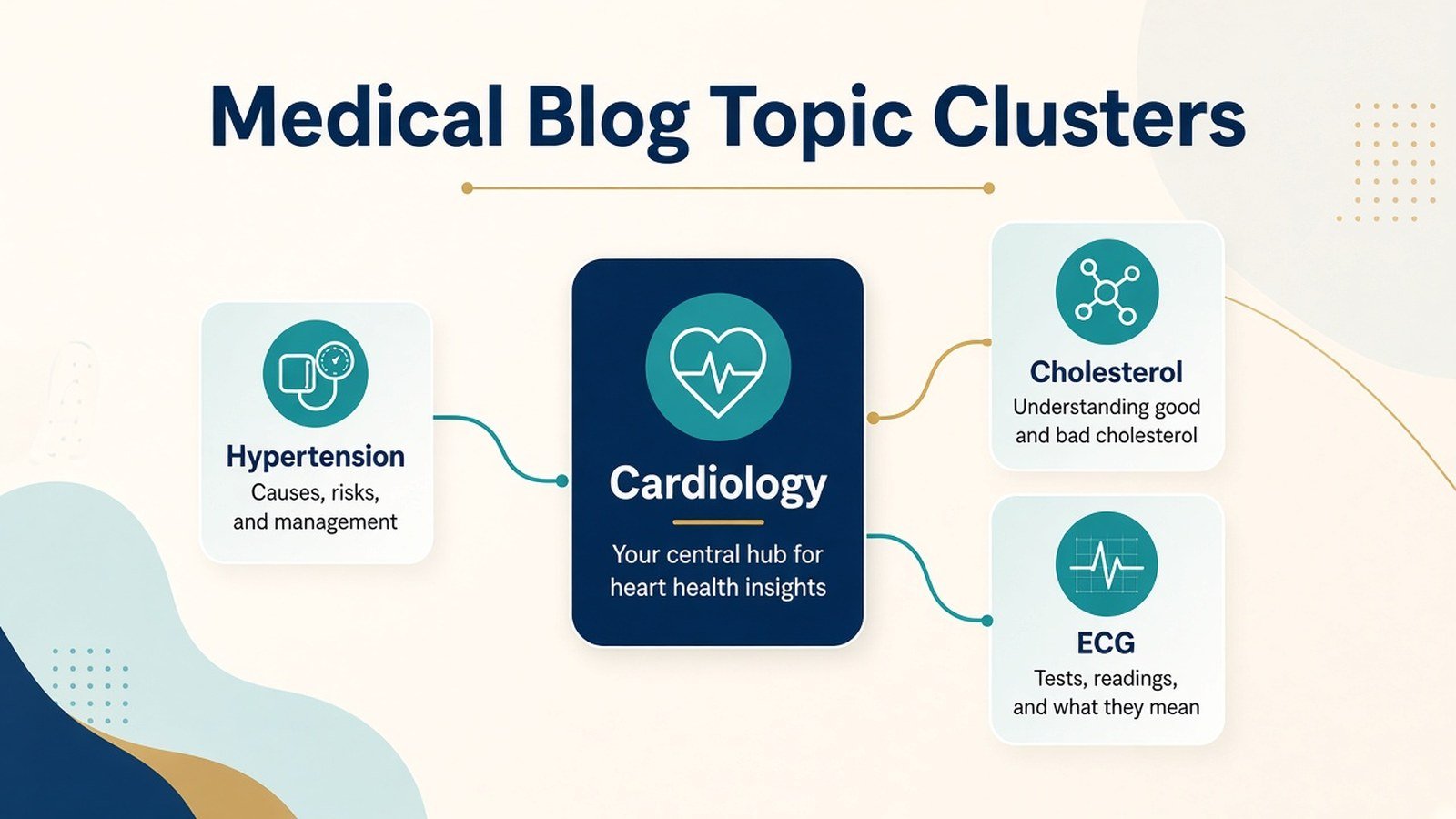
For example, a cardiology content section could include articles about hypertension, cholesterol, heart health assessments, and common cardiac diagnostic procedures. These articles would support a central cardiology page rather than competing with it for the same purpose.
This is the foundation of healthcare topic clusters: organising related content around a central subject and connecting the pages through meaningful internal links.
Understanding How Medical Blog Topic Clusters Work
A topic cluster generally contains three components: a pillar page, supporting articles, and contextual internal links.
The Pillar Page
The pillar page provides a broad introduction to a specialty or service. It explains what the specialty covers and directs visitors towards relevant information. For a cardiology department, the pillar page might describe consultation services, common areas of care, and available diagnostic facilities. It should serve as the main destination for people seeking information about the specialty and should align with the clinic’s actual services.
Supporting Blog Articles
Supporting articles explore narrower subjects within the specialty.
For example:
- Understanding common symptoms associated with hypertension.
- The relationship between cholesterol and heart health.
- Questions to discuss during a cardiology consultation.
- What patients should know before an ECG test.
Each article addresses a distinct informational need. It should provide enough context to be useful independently while connecting naturally to the wider specialty.
Internal Links
Internal links connect supporting articles with the pillar page and other relevant resources.
A blog discussing hypertension may link to the clinic’s cardiology service page when readers need information about consultations. An article explaining ECG testing may connect to a relevant diagnostic service page.
The links should help visitors move naturally from general information to relevant details. They should not be inserted simply to increase link volume.
Step-by-Step Process for Building a Medical Blog Content Strategy
A successful cluster begins with research and planning, not article production.
Step 1: Audit Existing Website Content
Before creating new articles, prepare an inventory of existing blog posts, specialty pages, and service pages.
Record:
- Page title and URL.
- Main topic and specialty.
- Primary keyword or search query.
- Search intent.
- Current internal links.
- Organic impressions and clicks, where available.
- Publication or last-update date.
Google Search Console can help identify which queries generate impressions and clicks for existing URLs.
This audit may reveal that the clinic already has useful articles that need updating, merging, or better internal linking. Creating another article on the same subject may add unnecessary duplication.
Step 2: Define Specialty Categories
Create a separate content category for each major specialty offered by the practice.
A hypothetical multi-specialty clinic might use the following structure:
| Specialty | Main content themes |
|---|---|
| Cardiology | Blood pressure, cholesterol, heart health |
| Dermatology | Acne, skin allergies, pigmentation |
| Orthopaedics | Joint pain, arthritis, sports injuries |
| Gynaecology | Menstrual health, reproductive health |
| Paediatrics | Child development, childhood health concerns |
These categories should reflect the clinic’s actual services and expertise.
Avoid building clusters around specialties that the practice does not provide simply because keyword tools indicate search demand.
Step 3: Research Patient Search Intent
A specialty can attract several types of searches. Understanding intent helps determine which content belongs in a cluster.
| Search intent | Example query | Suitable content |
|---|---|---|
| Informational | What causes high blood pressure? | Educational blog |
| Exploratory | When should someone consult a cardiologist? | Informational guide |
| Service-oriented | Cardiology clinic near me | Specialty or location page |
| Procedural | What happens during an ECG? | Diagnostic information page |
The distinction matters because not every search should lead to a blog article.
A person looking for a clinic may need a service page with location, consultation, and appointment information. Someone researching a health topic may benefit more from an educational article.
A strong content plan addresses both needs without making the blog compete with the service page.
Step 4: Select One Primary Keyword for Each Article
Assign one primary search query to each article and use supporting terms to develop the discussion.
For example, a dermatology cluster might include:
- Primary topic: causes of adult acne.
- Supporting topics: hormonal acne, acne triggers, dermatologist consultation, and acne treatment options.
These subjects can become separate articles only when each offers a distinct purpose and sufficient original value.
This is an important part of effective medical blog SEO. Repeating similar keywords across multiple articles does not automatically create stronger topical relevance.
Step 5: Establish a Consistent Internal Linking Structure
Each supporting article should link to its relevant specialty or service page where appropriate.
It may also link to other supporting articles when the connection genuinely helps readers.
For instance, an article about cholesterol could link to a cardiology service page and a related article about hypertension. The anchor text should describe the destination naturally.
Google recommends using descriptive anchor text so that users and search engines can understand linked pages.
Step 7: Introduce Clinical and Editorial Review
Healthcare content requires more careful review than ordinary lifestyle blogging.
A content workflow should include:
- Topic and search-intent approval.
- Research using reliable medical sources.
- Drafting by the content team.
- Clinical review by an appropriately qualified professional.
- Editorial and SEO review.
- Publication and internal linking.
- Periodic accuracy and performance reviews.
Articles should distinguish general educational information from individual medical advice. Avoid unsupported treatment claims, guaranteed outcomes, or language that encourages readers to self-diagnose.
Healthcare Content, Privacy and Editorial Compliance
Healthcare content clusters require clinical oversight because inaccurate information can influence how readers understand symptoms, procedures, and treatment options.
Marketing teams should establish a review process that includes:
- Clinical accuracy: Have qualified professionals review medical claims and educational explanations.
- Reliable sourcing: Prefer recognised medical organisations, government health resources and peer-reviewed research for factual claims.
- Clear authorship: Identify authors and clinical reviewers accurately. Never invent medical credentials or reviewer identities.
- Privacy protection: Do not include identifiable patient details, consultation records, or private photographs without appropriate authorisation and safeguards.
- Responsible language: Avoid guaranteed treatment outcomes, exaggerated claims, and advice that encourages self-diagnosis.
- Regular updates: Review articles when relevant clinical guidance, service availability, or supporting evidence changes.
The blog should provide general educational information, not replace individual medical assessment. Practices in India should also review applicable professional standards and data-protection requirements before publishing patient-related material.
How to Measure Topic Cluster Performance?
A cluster should be evaluated as a group of connected pages as well as through individual article performance.
Useful indicators include:
| Measurement | What it helps identify |
|---|---|
| Search impressions | Whether pages are appearing for relevant queries |
| Organic clicks | Whether search visibility is generating visits |
| Query relevance | Whether visitors find the intended information |
| Internal link engagement | Whether readers explore related pages |
| Service-page visits | Whether informational content leads to relevant service information |
| Enquiries | Whether the wider website journey generates meaningful contact |
Use Google Search Console to review queries, impressions, clicks and page-level performance. Analytics data can help assess engagement and navigation, provided tracking is configured appropriately.
Do not judge a cluster solely by the number of published articles or expect every supporting blog to generate direct enquiries. Some articles serve early research needs, while others support visitors who are already considering a consultation.
If a cluster receives impressions but few clicks, review whether titles and descriptions accurately communicate the content. If articles attract relevant traffic but receive little engagement, examine content usefulness, readability, and internal navigation. If service pages remain difficult to discover, improve contextual links and the website hierarchy.
Final Thoughts
Medical blog topic clusters help healthcare organisations turn scattered articles into an organised information resource. By grouping content around specialties, matching articles to search intent and connecting them to relevant service pages, clinics can create a more useful website experience.
An effective medical blog content strategy is not about publishing the largest number of articles. It is about building a focused library that answers patient questions, reflects clinical expertise and supports the practice’s actual services.
For clinics looking to strengthen this structure,
specialty content marketing
should work alongside technical optimisation, useful internal links and ongoing performance reviews. These activities form part of a broader healthcare SEO approach.
Doctors Branding provides
healthcare SEO services
that include the strategic work involved in improving website content structure, search visibility, and organic discoverability. The objective is to build a coherent digital resource that serves readers while supporting the clinic’s long-term online presence.
Keep reading
More from the Doctors Branding blog
-
How to Improve Internal Linking on a Medical Website?
A practical medical website internal linking method: audit orphan pages, build speciality clusters, set link rules, and check patients can...
Read article → -

Local SEO Beyond Google Business Profile: Other Signals Doctors Can Manage
Local SEO beyond Google Business Profile: other signals doctors can manage, from consistent listings and service pages to reviews and...
Read article → -
Local SEO for Diagnostic Centres and Pathology Labs
Practical local SEO for diagnostic centres: fix Google profiles, build unique lab pages, keep details consistent, and measure results for...
Read article →
Want this kind of thinking applied to your practice?
Start with a conversation about where your doctor, clinic or hospital marketing stands today.