
How to Track Calls and Appointment Enquiries from Healthcare Ads?
How to track calls and appointment enquiries from healthcare ads: set up call and form conversions, check the data and respect patient privacy.
Picture a dermatology clinic in Salt Lake that spends a fixed amount on Google Ads every month. The dashboard shows plenty of “conversions,” yet the front desk says the phone has been quiet. Both can be true, and that gap is where a lot of healthcare ad budget disappears.
This guide is for clinic owners, practice managers, and marketing teams who want to know which ads lead to appointment requests. It covers the setup, checks, and privacy rules for healthcare PPC conversion tracking in India.
Why is tracking enquiries harder for clinics?
An online store has a checkout page. A clinic has a receptionist, a phone that rings during OPD hours, WhatsApp, a booking form, and the occasional walk-in who “saw you on Google.”
Most of those touchpoints happen outside the ad platform. If you can’t connect a booked appointment back to the campaign and keyword that produced it, Google’s automated bidding will optimise towards whatever you did tell it to count. Often that is a tap on a phone icon, which doesn’t mean a patient wanted to book.
With bad data, you may pause the campaign that fills your Saturday slots and keep funding one that brings wrong-number calls. Good medical Google Ads tracking exists to answer one question reliably: which spend produced real appointment requests?
The principles behind reliable tracking
Agree on these ground rules with whoever manages your ads.
- Count enquiries, not engagement. A tap on a “Call now” button records intent to dial, not a conversation. Track the call itself, with a minimum duration.
- One patient intent, one conversion. If a patient fills the form and then calls to confirm, that is one enquiry. Decide in advance how you’ll handle duplicates.
- Separate primary from secondary actions. Google Ads lets you mark some conversion actions as primary (used for bidding) and others as secondary (reported only). Booking requests and qualified calls belong in primary. Button clicks and page views do not.
- Keep health information out of ad and analytics platforms. You need to know that someone enquired, not what they are suffering from.
- Reconcile against the front desk. Reception records are closer to the truth than platform estimates.
A step-by-step setup method
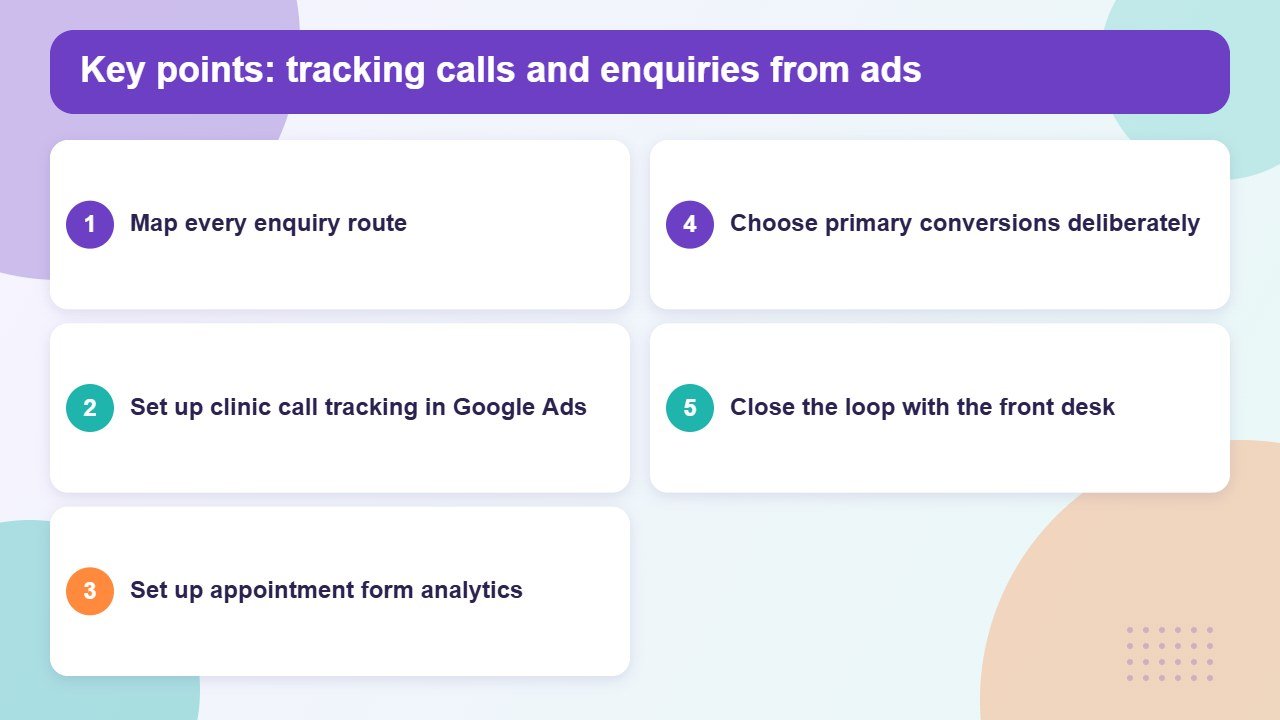
Step 1: Map every enquiry route
List each way a patient can reach you after seeing an ad: calling straight from the ad, calling a number on the website, submitting an appointment form, using a booking widget, messaging on WhatsApp, or arriving in person. Each needs its own clinic call tracking method; walk-ins can only be captured manually.
Step 2: Set up clinic call tracking in Google Ads
Google offers three call-related conversion types that matter most for clinics.
- Calls from ads. Add a call asset to Search campaigns and keep call reporting switched on. Google then shows a Google forwarding number in the ad, and you set a minimum call length for a call to count as a conversion. Google forwarding numbers are available in India.
- Calls from your website. A snippet on your site swaps your listed number for a forwarding number when a visitor arrives from an ad so that calls can be tied back to the keyword and campaign.
- Imported call conversions. If you track calls in a CRM or call-tracking system, you can import qualified calls. Be aware that Google states this method is supported for only a portion of calls in India.
Two India-specific details matter. Google’s call reporting doesn’t show caller phone numbers for calls in India, so you can’t match ad calls to patients by number. Indian users may also see a “missed call” option on call ads, which triggers an automated call back. Factor both into how your team logs calls.
A third-party call tracking provider can add recording and lead scoring. Check where recordings are stored and how callers are informed.
Step 3: Set up appointment form analytics
Track successful form submissions, not form views. The cleanest options are a dedicated thank-you page that loads only after a valid submission, or a form-submit event sent through Google Tag Manager to GA4 and imported into Google Ads.
Go further with appointment form analytics: track form starts and which field people abandon. If many leave at “Upload previous reports”, the problem is the form, not the ads.
Never pass names, phone numbers, email addresses, or symptoms in page URLs, event names, or event parameters. Google’s own guidance prohibits sending personally identifiable information to Google Analytics, and URLs are where it most often leaks by accident.
Step 4: Choose primary conversions deliberately
A sensible starting set for most clinics:
- Primary: calls from ads above your minimum duration, website calls above the same threshold, completed appointment forms, confirmed online bookings.
- Secondary: clicks on phone numbers, WhatsApp button clicks, directions requests.
Set the call threshold by listening to real enquiries at reception. A 20-second call is often a timing question; a booking usually takes longer.
Step 5: Close the loop with the front desk
Add a simple “How did you hear about us?” field to the reception register or practice management software, with “Google search ad” as an option. For forms, store the GCLID (the click identifier Google adds to ad URLs) in a hidden field, so you can later import confirmed appointments as offline conversions. Only do this with a clear consent notice on the form and the involvement of whoever handles your data protection.
Illustrative example: a two-doctor ENT clinic in Kolkata
This is a hypothetical scenario created for explanation. It is not a client result.
An ENT practice in South Kolkata runs Search ads for “ENT doctor near me” and “hearing test Kolkata”. Enquiries arrive by phone and through a short booking form.
| Enquiry route | How it’s tracked | Primary? |
|---|---|---|
| Call from ad | Call asset with call reporting, 60-second minimum | Yes |
| Call from website | Website call conversion snippet, 60-second minimum | Yes |
| Booking form | Thank-you page event in GA4, imported to Google Ads | Yes |
| WhatsApp click | GA4 click event | No |
| Walk-in mentioning Google | Reception register | Reviewed monthly |
Each week, the practice manager compares Google Ads conversions with new-patient requests in the register that list Google as the source. If the platform reports far more than reception sees, tracking gets audited before any budget changes.
Setup checklist
- Every enquiry route listed and assigned a tracking method
- Call reporting on; minimum call duration agreed with reception
- Website call conversion snippet tested on mobile
- Form conversion fires only after a valid submission
- No patient details in URLs, event names or parameters
- Primary and secondary conversions set
- Consent notice on every form
- Weekly reconciliation with the front desk scheduled
Common mistakes, limitations and compliance points
Common mistakes:
- Counting tel: link clicks as phone calls.
- Importing the same form conversion from both GA4 and a Google Ads tag, so every enquiry counts twice.
- A thank-you page that is indexed or reachable directly, inflating conversions.
- Counting existing patients calling about reports as new enquiries.
- Changing bid strategies the same week tracking changes.
Limitations to accept. Forwarding numbers work inside Google Ads and on your site, not on hoardings or printed flyers. Call assets on the Display Network don’t support forwarding numbers or call conversion tracking.
Privacy and platform policy. India’s Digital Personal Data Protection Act, 2023 now has operating rules: the DPDP Rules, 2025 were notified in November 2025, with obligations phasing in over roughly 12 to 18 months. Clinics should review consent notices, retention periods, and vendor contracts now.
On the advertising side, Google treats personal health as a sensitive interest category under its Personalized advertising policy. In practice, that means you should not build remarketing lists from visitors to condition-specific pages and then target them about that condition. Google’s Healthcare and medicines policy also restricts certain healthcare content and requires certification for some categories, so check the current policy for your services before launching.
This article is marketing guidance, not legal or medical advice. For specific data protection obligations, speak to a qualified legal adviser.
How to measure progress and decide the next step?
Once tracking is stable, watch these numbers:
- Cost per qualified enquiry: spend divided by primary conversions.
- Enquiry-to-appointment rate: taken from reception records, not the ad platform.
- Missed-call share: how many ad calls went unanswered.
- Form completion rate: form starts versus submissions.
Then decide the next action:
- Ad conversions are high, but reception sees few new patients? Audit the tracking first.
- Lots of missed calls during lunch or evening? Fix staffing or adjust ad scheduling before raising bids.
- Strong form starts but weak completions? Shorten the form.
- Steady, reconciled conversion data over several weeks? Now it makes sense to test conversion-based bidding.
Review weekly for the first two months, then monthly.
Summary
Reliable healthcare PPC conversion tracking comes down to a few habits: track real calls and completed forms rather than clicks, keep patient details out of your platforms, separate primary from secondary actions, and check the numbers against what your front desk actually sees. None of this guarantees more patients, but it does tell you which ads are worth funding.
To see how these measurement steps fit into campaign management for clinics, the Doctors Branding Agency Healthcare PPC service page explains the approach.
Related Reading
- Why Booked Appointments and Form Leads Are Different Marketing Measures
- How to Remove Unnecessary Health Questions From Marketing Lead Forms
- Negative Keywords for Medical Google Ads: How to Reduce Irrelevant Clicks
Further reading: Google Ads policy on healthcare and medicines.
Keep reading
More from the Doctors Branding blog
-
How Can New Clinics Build Local Search Visibility Before Launch?
Local SEO for new clinics: a pre-launch timeline for Google Business Profile, website, directories and local pages, built within NMC...
Read article → -
Local SEO Reporting for Doctors: Calls, Directions and Enquiries
Local SEO reporting for doctors: track calls, direction requests and enquiries from Google listings, and turn monthly numbers into decisions.
Read article → -
Healthcare PPC Keyword Match Types: A Practical Guide for Clinics
Healthcare PPC keyword match types explained: when clinics should use exact, phrase or broad match, with negatives and compliance checks.
Read article →
Want this kind of thinking applied to your practice?
Start with a conversation about where your doctor, clinic or hospital marketing stands today.