How Can New Clinics Build Local Search Visibility Before Launch?
Local SEO for new clinics: a pre-launch timeline for Google Business Profile, website, directories and local pages, built within NMC rules.
Local SEO for new clinics should start three to six months before opening day. The groundwork is a verified Google Business Profile with a future opening date, a website that is live and crawlable well ahead of launch, identical contact details across directories, and a handful of useful local pages. None of this guarantees rankings on day one. It gives Google, and the people living nearby, something accurate to find when they start looking.
Why do the months before opening matter?
Most owners spend the pre-launch months on fit-out, hiring and licences, and push the online side to “the week before.” But local search rewards things that take time to settle: a verified listing, a site that Google has crawled and understood, directory listings that agree with each other, and a track record of activity. Start all of it on opening day and your digital front door opens months after your physical one.
Patients also look ahead. Someone who walks past your half-finished signboard and searches for a clinic nearby should find your listing, opening date included, rather than an established practice down the road.
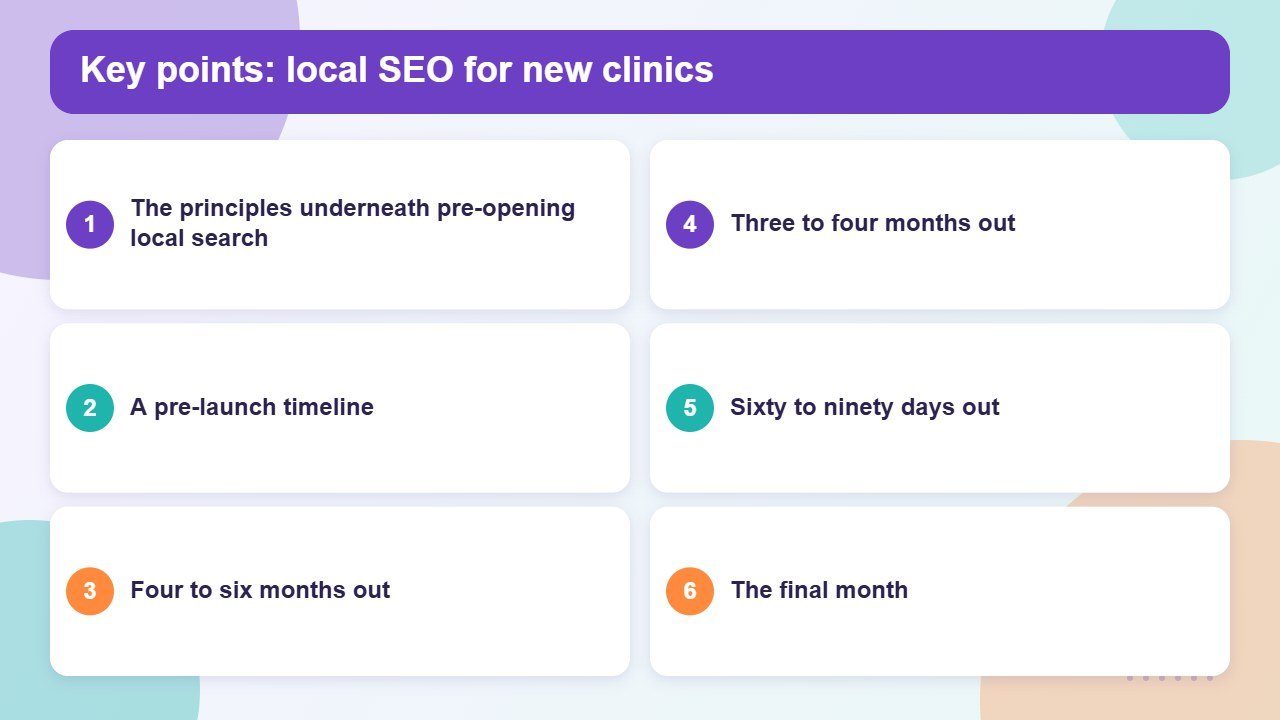
The principles underneath pre-opening local search
- Consistency matters more than volume. Search engines cross-check your name, address, phone number, and hours across your website, Business Profile, and directories. Ten listings that match exactly do more for you than forty that contradict each other.
- Relevance comes from real information. Your actual services, the doctors’ qualifications, and the area you serve give Google context. Keyword-stuffed business names don’t; they break Google’s guidelines, and Google often strips the extra words anyway.
- Trust can’t be claimed, only earned. In healthcare, this is a compliance question as much as a marketing one, and the rules in India changed recently (covered below).
A pre-launch timeline
Good new medical practice SEO works backwards from the opening date.
Four to six months out
- Fix the clinic’s display name, the exact address format, and a dedicated phone number. Write them down once and copy that version everywhere.
- Get a basic website live: home, doctors, services, location, and contact. A plain site Google can crawl now is worth more than a polished one that launches late.
- Set up Google Search Console and submit a sitemap.
Three to four months out
- Create the Google Business Profile. Google lets you enter an opening date up to a year in the future, and once the profile is verified, it starts showing on Google 90 days before that date. You can choose “verify later” and add the date first.
- Choose the primary category carefully (“Physiotherapist”, “Dental clinic”, “Pediatrician”) and add secondary categories only for services you genuinely provide.
- Decide early whether individual doctors need their own profiles. Google has separate rules for practitioner listings, so read them before creating anything.
Sixty to ninety days out
- Add real photos as the space comes together: exterior, signage, reception, treatment rooms. Google itself suggests photos as a way to show progress from construction to opening day.
- List the clinic on relevant directories such as Practo, Justdial, Bing Places, and Apple Business Connect, using the identical details.
- Publish a location page that answers practical questions: nearest metro station, landmarks, parking, wheelchair access.
The final month
- Add structured data (MedicalClinic or LocalBusiness schema) to the site, matching the profile details exactly.
- Use Business Profile posts for opening hours, appointment booking and opening-day information.
- Test the enquiry form on mobile and add a clear consent line.
Illustrative example: a pre-launch checklist
This scenario is fictional and is here to show the method. It is not a client case study and includes no real results.
Picture a two-doctor physiotherapy clinic planning to open in Salt Lake, Kolkata, in March. A workable pre-opening local search checklist for them might look like this:
| Task | Target | Done when |
|---|---|---|
| Final name, address, and phone agreed | October | Saved in one shared document |
| Website live with five core pages | October | Pages show as indexed in Search Console |
| Business Profile created, opening date set | November | Profile verified |
| Profile visible with “opening soon” | December | Appears in a branded search |
| Photos and services added | December–January | At least 10 real photos uploaded |
| Directory listings built | January | Spot-check shows details match everywhere |
| Location page published | January | Covers metro access and parking |
| Schema added and tested | February | Passes Google’s Rich Results Test |
Each task has a clear “done” condition, so the practice manager can see what’s slipping.
Common mistakes, limits and compliance considerations
A few things go wrong often:
- Changing the clinic name or phone number after listings are built, which leaves mismatched data across the web.
- Using a doctor’s home or a virtual office address. The profile address should be where patients are actually seen.
- Letting the profile go quiet once the clinic opens.
Be realistic about limits, too. Proximity to the searcher carries real weight, and a new clinic in a crowded area may take months to compete with practices that have years of history. Pre-launch work shortens that gap; it doesn’t erase it.
On compliance, Indian clinics need to pay close attention. The National Medical Commission issued its Guidelines on Ethical Advertising and Public Communication on 6 October 2026, with immediate effect. They define advertising broadly, covering websites, blogs, social media and messaging apps.
Registered medical practitioners must not request or share patient testimonials for promotion, and no doctor or institution may solicit or publish fake, paid, or misleading reviews. Claims like “best doctor” or “number one” are also off the table.
That changes how clinic launch marketing should approach reviews: build a neutral feedback process, avoid incentives or scripts, and have the guidelines checked against your plans by someone qualified before you start.
Patient privacy is the other line not to cross. Never use patient photos or identifiable details in posts, collect only what the enquiry form needs, and handle consent in line with India’s Digital Personal Data Protection Act. Any health information on the website should be reviewed by the treating clinicians, and it should read as general information, not medical advice.
How to measure progress and decide what to do next?
Before opening, track readiness rather than traffic:
- Is the Business Profile verified and showing with its opening date?
- How many of your pages does Search Console show as indexed?
- Are you getting impressions for searches that include your clinic name or your area?
- Does a quick audit show the same details on every directory?
After opening, add profile views, calls, direction requests, and website clicks.
Use the numbers to choose the next action. If pages aren’t indexed after four to six weeks, look at technical issues first. If the profile is live but impressions are flat, revisit categories, services, and the location page. If people find you but don’t call, the problem is more likely the profile content, photos, or booking process than visibility.
Final Words
Pre-opening local search is mostly unglamorous setup: one consistent set of details, an early website, a verified profile with a future opening date, accurate directories and pages that answer real questions. Started three to six months ahead, it gives the clinic a findable presence from day one, built within NMC rules and patient-privacy law.
For clinics that want to see how this fits into a wider plan, Doctors Branding Agency’s Local SEO and healthcare marketing pages set out the services and process involved.
Related Reading
- How to Keep Clinic Business Information Consistent Across the Web?
- Local SEO Reporting for Doctors: Calls, Directions and Enquiries
- Google Maps Ranking Factors for Clinics: What You Can Actually Control
Further reading: Google Business Profile guidelines for representing your business.
Keep reading
More from the Doctors Branding blog
-
Google Ads Campaign Structure by Medical Specialty
Medical Google Ads campaign structure by specialty: separate budgets, intent-based ad groups, location targeting and tracking for each service.
Read article → -
Local SEO Reporting for Doctors: Calls, Directions and Enquiries
Local SEO reporting for doctors: track calls, direction requests and enquiries from Google listings, and turn monthly numbers into decisions.
Read article → -
How to Track Calls and Appointment Enquiries from Healthcare Ads?
How to track calls and appointment enquiries from healthcare ads: set up call and form conversions, check the data and...
Read article →
Want this kind of thinking applied to your practice?
Start with a conversation about where your doctor, clinic or hospital marketing stands today.